
📞
BSIS PPO License: 122365
+1 (818) 966-2279
✉️
Sahnaz@workforcesecurityservices.com

The Legal and Ethical Risks of AI in U.S. Security Services
Artificial intelligence is rapidly transforming private security in the United States. AI-powered video analytics, facial recognition systems, automated access control, anomaly detection, behavioral monitoring, and predictive threat assessment tools are increasingly marketed as force multipliers for modern security operations. For private security providers, commercial property managers, corporate security teams, and critical infrastructure operators, these technologies promise greater efficiency, faster incident detection, and reduced operational blind spots.
However, AI adoption in private security comes with significant legal and ethical risks that many organizations underestimate.
Unlike traditional surveillance technologies, AI systems often make probabilistic judgments about identity, behavior, or risk. That distinction matters. A false alert generated by conventional CCTV may simply be a nuisance. A false alert generated by AI can result in wrongful detention, discrimination claims, privacy violations, regulatory scrutiny, or litigation.
The challenge is compounded by the fragmented regulatory environment in the United States. There is no single federal AI surveillance law governing private security use cases. Instead, organizations must navigate a complex patchwork of biometric privacy statutes, state consumer privacy laws, municipal restrictions, FTC enforcement expectations, contractual obligations, and civil liability exposure.
For security leaders, the question is no longer whether AI can improve operations. The more important question is whether AI can be deployed responsibly, lawfully, and defensibly.
America’s Fragmented AI Compliance Landscape
One of the greatest legal risks associated with AI in private security is regulatory inconsistency.
Unlike sectors governed by centralized federal rules, private security organizations must navigate multiple layers of legal oversight. What is legally permissible in one jurisdiction may create immediate legal exposure in another.
Relevant regulatory influences include:
- state biometric privacy laws
- consumer privacy statutes
- municipal facial recognition restrictions
- FTC consumer protection enforcement
- employment law
- anti-discrimination law
- contract law
- negligence and tort liability
This fragmented environment creates significant compliance challenges for multi-state security operators.
For example, a security company deploying facial recognition in Illinois may face substantially different legal obligations than a similar deployment in California or Texas. A vendor-certified “compliant” AI solution may still fail local legal requirements depending on implementation.
Compliance cannot be treated as a generic checkbox exercise.
Biometric Privacy Laws: The Highest-Risk Legal Exposure
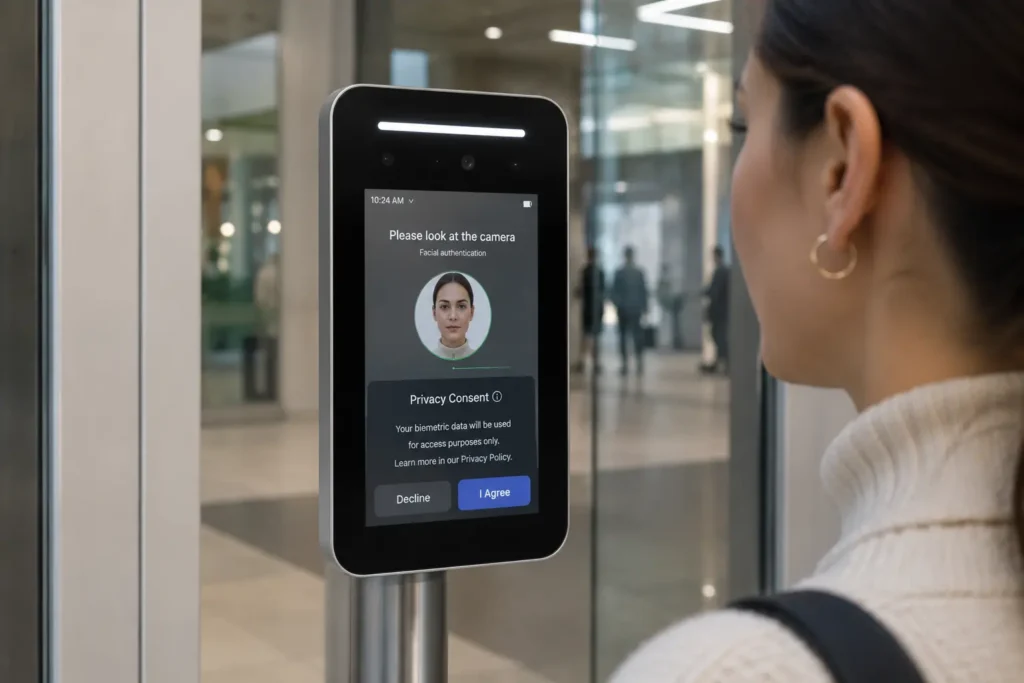
Among all AI-related legal issues in private security, biometric data regulation represents one of the most serious risk categories.
AI-powered identity verification systems frequently process biometric identifiers such as:
- facial geometry
- fingerprints
- iris scans
- voiceprints
- biometric templates derived from video footage
Biometric data receives heightened legal scrutiny because it is inherently sensitive. Unlike passwords, biometric identifiers cannot simply be reset if compromised.
Illinois BIPA: A Major Litigation Risk
The Illinois Biometric Information Privacy Act (BIPA) remains one of the most consequential biometric privacy laws affecting AI deployments.
BIPA imposes strict obligations on organizations collecting biometric identifiers, including requirements related to:
- informed written consent
- advance notice
- publicly available retention schedules
- secure handling obligations
- destruction policies
- restrictions on selling or profiting from biometric data
What makes BIPA especially significant is its private right of action. Individuals may bring lawsuits directly, making litigation risk substantial.
For a private security firm, this matters because liability may arise not only from direct biometric collection but also through deployment of third-party AI platforms processing biometric information on their behalf.
Purchasing technology from a vendor does not automatically transfer legal responsibility.
California Privacy Law and Surveillance Data Governance
California presents another major compliance environment.
The California Consumer Privacy Act (CCPA), as amended by the California Privacy Rights Act (CPRA), expands consumer privacy obligations around personal data collection, disclosure, retention, and access rights.
AI surveillance systems often collect data falling within broad privacy definitions, including:
- video recordings
- location-linked metadata
- identity-linked access logs
- behavioral analytics
- biometric-derived information
Organizations using AI security tools in California may need to address:
- disclosure requirements
- consumer access rights
- deletion obligations
- retention limitation expectations
- data-sharing transparency
- Vendor contractual controls
Even if an organization considers surveillance “security infrastructure,” privacy obligations may still apply depending on context.
Security exceptions are not unlimited shields.
Facial Recognition Restrictions: A Moving Regulatory Target
Facial recognition technology occupies one of the most controversial positions in AI governance.
Although private sector use is not uniformly prohibited nationwide, restrictions continue to evolve.
Certain municipalities have enacted facial recognition limitations, often focused initially on public-sector use. However, broader policy momentum around surveillance governance continues to influence private-sector expectations.
This creates practical confusion.
A security operator may reasonably assume facial recognition is legally acceptable because the technology is commercially available. That assumption can be dangerously simplistic.
Key legal questions include:
- Is facial recognition allowed in this jurisdiction?
- Are notice requirements mandatory?
- Does the use case involve employees, visitors, residents, or consumers?
- Is biometric consent required?
- Is data retained or processed externally?
- Does vendor cloud processing trigger additional obligations?
Legal permissibility depends heavily on deployment details.
Wrongful Identification: When AI Errors Become Legal Events
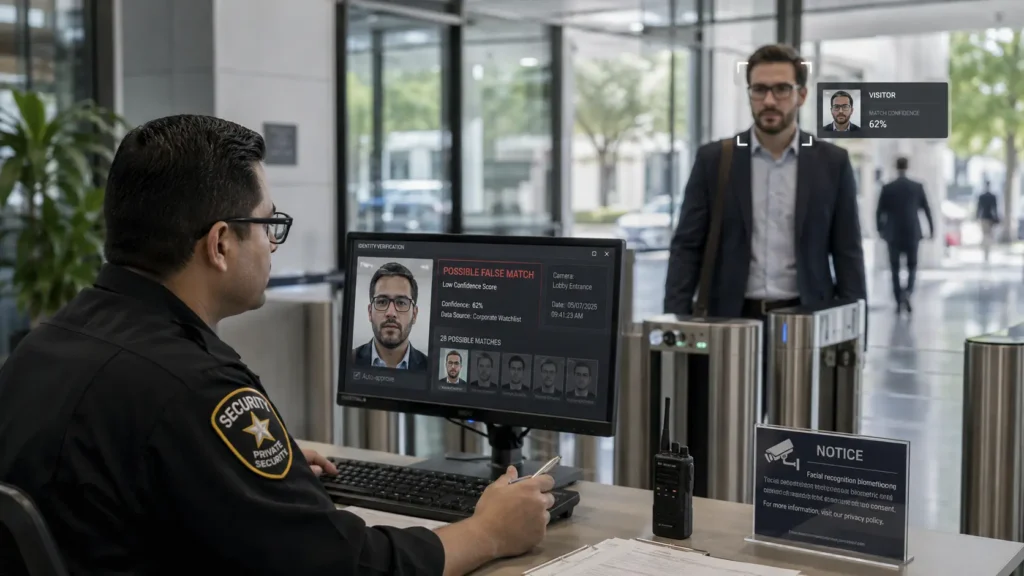
AI systems are probabilistic, not infallible.
Facial recognition, behavioral analytics, and automated threat scoring systems can generate false positives. In private security environments, those errors can have serious real-world consequences.
Examples include:
- An employee was wrongly flagged as unauthorized
- A visitor was denied access due to misidentification
- a contractor falsely associated with a prior incident
- a customer incorrectly labeled suspicious
- An AI-generated alert triggers aggressive intervention
The legal consequences may extend far beyond technical inconvenience.
Potential claims may include:
- negligence
- false imprisonment
- defamation
- invasion of privacy
- emotional distress
- reputational harm
- breach of contract
- wrongful exclusion
For example, if a security officer detains an individual based primarily on faulty AI-generated identification, plaintiffs may argue the organization failed to exercise reasonable care.
AI errors do not remain abstract software issues once they affect human treatment.
They become legal events.
Algorithmic Bias and Discrimination Risk
AI systems raise another major ethical and legal concern: discriminatory outcomes.
Historically, concerns have emerged around differential performance in facial recognition and automated classification systems across demographic groups.
Even if a security organization has no discriminatory intent, biased outputs may create liability if systems disproportionately misidentify certain populations or trigger unequal intervention patterns.
Potential exposure areas include:
- employment discrimination claims
- public accommodation disputes
- civil rights allegations
- accessibility-related concerns
- contractor fairness disputes
Risk scenarios include:
- Repeated false positives affecting specific demographic groups
- unequal access denials
- disproportionate “high-risk” behavioral scoring
- selective intervention patterns reinforced by biased data
Ethically, this raises questions about fairness, accountability, and transparency.
Legally, it creates exposure where organizations fail to validate AI performance before deployment.
Accuracy metrics alone are insufficient if fairness impacts are ignored.
Data Retention and Information Governance Risks
AI surveillance platforms frequently generate far more data than traditional security systems.
This may include:
- archived video
- event metadata
- biometric templates
- anomaly detection logs
- access control histories
- alert decision records
- user interaction logs
- cloud analytics records
Without governance, overcollection becomes a serious liability.
Critical compliance questions include:
- How long is surveillance data retained?
- Is retention legally justified?
- Who owns the data?
- Can data be permanently deleted?
- Is vendor access restricted?
- Is data used to train external AI models?
- Are breach notification obligations triggered if compromised?
Retention risk is often underestimated.
The longer sensitive data is stored, the greater the exposure window for misuse, unauthorized access, litigation discovery, or cybersecurity incidents.
Retention should be intentional, documented, and legally reviewed.
Consent and Notice on Private Property
A common misconception is that private property ownership creates unrestricted surveillance authority.
That assumption is legally dangerous.
Context matters significantly.
AI surveillance deployment in environments such as:
- office buildings
- apartment communities
- gated residential developments
- retail premises
- warehouses
- logistics hubs
- schools
- healthcare-adjacent properties
may trigger different notice, privacy, employment, or contractual obligations.
Relevant considerations include:
- employee notice requirements
- visitor disclosure expectations
- tenant lease obligations
- contractor consent frameworks
- surveillance signage adequacy
- biometric authorization requirements
Private property rights do not automatically override privacy considerations.
Especially where biometric or identity-linked processing is involved, transparency becomes essential.
FTC Scrutiny and Deceptive AI Claims
AI legal risk does not stop at operational use.
It also extends to procurement and vendor representations.
The Federal Trade Commission has increasingly signaled concern around deceptive AI marketing claims, including exaggerated assertions regarding:
- accuracy
- bias elimination
- autonomous threat detection
- compliance guarantees
- fairness assurances
- risk prediction reliability
This matters because many security buyers rely heavily on vendor marketing.
Claims such as:
“99.9% accurate facial recognition”
“bias-free AI decisioning”
“fully compliant surveillance intelligence”
should not be accepted without independent validation.
If organizations rely on misleading claims and deploy defective systems, liability may remain with the deploying entity.
Vendor marketing is not a legal defense.
Vendor Accountability: The Hidden Governance Risk
Third-party vendors often represent the largest overlooked risk in AI security deployments.
Critical due diligence questions include:
- Has the AI model been independently audited?
- What training data was used?
- What demographic validation exists?
- How are false positives measured?
- Can performance drift be monitored?
- Who owns collected data?
- Is subcontractor processing involved?
- What indemnification protections exist?
- Are contractual liability caps adequate?
- What happens after a data breach?
Procurement teams frequently focus on operational capability while underweighting governance risk.
That imbalance can be costly.
A sophisticated AI procurement strategy must include legal review, technical validation, and compliance governance.
Ethical Governance Beyond Legal Minimums
Legal compliance should be treated as the floor, not the ceiling.
Even if an AI deployment is technically lawful, ethical concerns may remain.
Responsible governance requires asking broader questions:
- Is this surveillance proportionate?
- Is human oversight meaningful?
- Can decisions be challenged?
- Are affected individuals aware of monitoring?
- Is intervention escalation justified?
- Are vulnerable populations disproportionately affected?
- Is auditability preserved?
Private security exists to protect people and property—not to create opaque automated risk environments lacking accountability.
Trust matters.
Ethical failures often become legal failures over time.
Strategic Recommendations for Security Leaders
Organizations considering AI in security operations should adopt disciplined governance.
Practical priorities include:
Conduct a legal review before deployment
Map jurisdiction-specific obligations before implementation.
Perform biometric impact assessments
Evaluate whether biometric processing introduces elevated exposure.
Require vendor due diligence
Do not rely solely on marketing claims.
Establish human oversight protocols
Avoid fully automated intervention pathways.
Create false-positive response procedures
Ensure staff understand escalation and verification expectations.
Limit retention intentionally
Store only what is necessary for legitimate operational purposes.
Audit for fairness and bias
Validate real-world performance regularly.
Strengthen contract protections
Address indemnification, audit rights, breach response, and compliance obligations.
Train security personnel appropriately
Human misuse can amplify AI risk.
Conclusion
AI offers meaningful advantages for private security, from faster threat detection to expanded situational awareness.
But the greatest risk is not the technology itself.
It is deploying powerful surveillance systems without adequate governance, legal discipline, and ethical accountability.
For private security leaders, the future will not belong simply to organizations that adopt AI first.
It will belong to those who deploy it responsibly.