
📞
BSIS PPO License: 122365
+1 (818) 966-2279
✉️
Sahnaz@workforcesecurityservices.com

What Is Crime Prevention Through Environmental Design (CPTED)?
Crime prevention is often associated with security guards, surveillance cameras, and alarm systems. While these tools are important, there is another widely recognized approach that focuses on preventing crime through the way spaces are designed and managed. This approach is known as Crime Prevention Through Environmental Design (CPTED).
CPTED is a security strategy that uses thoughtful design, layout, and maintenance of physical spaces to reduce opportunities for crime. Instead of relying only on reactive measures after incidents occur, CPTED focuses on creating environments that naturally discourage criminal behavior.
Today, CPTED principles are used by urban planners, architects, security professionals, and property managers to improve safety in commercial buildings, residential communities, public areas, and business facilities. By understanding and applying these principles, organizations can create environments that promote visibility, control access, and encourage responsible use of shared spaces.
This article explains what CPTED is, how it works, and why it has become an important part of modern security planning.
Understanding the Concept of CPTED
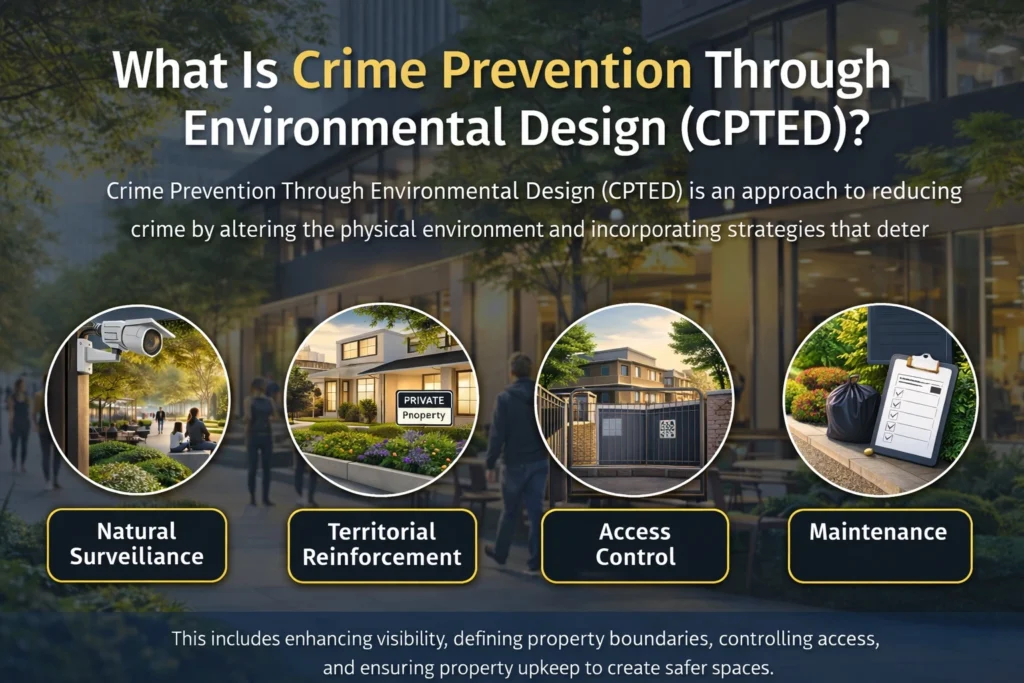
Crime Prevention Through Environmental Design is based on the idea that the physical environment plays a significant role in influencing human behavior. When spaces are poorly designed, poorly lit, or neglected, they may create opportunities for crime. On the other hand, well-designed environments can make criminal activity more difficult and less attractive.
CPTED focuses on shaping the built environment in ways that increase natural observation, improve access control, and reinforce a sense of ownership over a space.
For example, a commercial property that has clear sightlines, adequate lighting, defined entrances, and regular maintenance is less likely to attract criminal activity than a poorly maintained property with hidden areas and limited visibility.
By addressing environmental factors, CPTED helps reduce risks before incidents occur.
The Origins of CPTED
The concept of Crime Prevention Through Environmental Design was first developed in the 1970s by criminologist C. Ray Jeffery, who introduced the term in his book Crime Prevention Through Environmental Design. Around the same time, architect Oscar Newman contributed similar ideas through his theory of Defensible Space, which emphasized the importance of design in controlling and protecting residential environments.
These early studies highlighted the connection between urban design and crime patterns. Researchers found that environments with poor visibility, unclear boundaries, and weak community ownership often experienced higher crime rates.
Over time, CPTED principles evolved and became widely accepted as part of modern security and urban planning strategies.
Today, CPTED concepts are used worldwide by governments, businesses, and security professionals to improve safety in both public and private spaces.
The Core Principles of CPTED
Although CPTED strategies can vary depending on the property or location, most implementations are built around several key principles. These principles focus on improving visibility, controlling access, and maintaining environments that discourage criminal activity.
Natural Surveillance
Natural surveillance is one of the most important CPTED principles. It focuses on designing spaces so that people can easily observe what is happening around them.
When areas are visible and open to observation, potential offenders are less likely to engage in criminal behavior because they feel they may be seen.
Examples of natural surveillance include:
- installing proper lighting in parking lots and walkways
- placing windows that face public areas
- removing visual barriers such as tall shrubs or walls
- designing open layouts that improve visibility
Well-lit and visible environments increase the perception of risk for offenders and improve safety for legitimate users of the space.
Natural Access Control
Natural access control focuses on guiding how people enter and move through a space. By controlling entry points and directing traffic flow, property owners can reduce opportunities for unauthorized access.
Examples of natural access control include:
- security gates and fencing
- clearly defined building entrances
- reception areas or front desks
- key card or badge entry systems
- barriers that prevent unauthorized vehicle access
Access control helps ensure that only authorized individuals can enter restricted areas, which reduces the likelihood of theft, vandalism, or trespassing.
Territorial Reinforcement
Territorial reinforcement emphasizes the importance of creating a clear sense of ownership over a space. When a property looks well-maintained and clearly belongs to someone, it sends a signal that the area is monitored and protected.
This perception can discourage criminal behavior.
Examples of territorial reinforcement include:
- property signage
- landscaping that defines boundaries
- fencing or decorative barriers
- clearly marked walkways and entrances
These elements communicate that a space is actively managed and that unauthorized activity may be noticed.
Maintenance and Management
Maintenance is an essential part of CPTED because neglected environments can quickly attract criminal activity. When buildings appear abandoned or poorly maintained, offenders may assume that the property is not actively monitored.
Regular maintenance demonstrates that the property is cared for and supervised.
Examples include:
- repairing broken lighting fixtures
- removing graffiti promptly
- maintaining landscaping and visibility
- keeping public areas clean and organized
Proper maintenance reinforces the message that the property is actively managed and protected.
How CPTED Benefits Businesses
Businesses in large metropolitan areas such as Los Angeles can benefit greatly from applying CPTED principles. Commercial properties often experience high foot traffic and may contain valuable assets, making them potential targets for theft or vandalism.
By improving environmental design, businesses can reduce vulnerabilities and create safer spaces for employees and customers.
Benefits of CPTED for businesses include:
- improved visibility and safety
- reduced opportunities for theft and vandalism
- better control over building access
- increased confidence among employees and visitors
In many cases, CPTED strategies work best when combined with other security measures such as surveillance systems and professional security personnel.
Examples of CPTED in Commercial Properties
CPTED principles can be applied in many types of commercial environments. Each property may require different design strategies depending on its layout, operations, and risk level.
Some examples include:
Office Buildings
Clear entry points, monitored reception areas, and well-lit parking facilities improve both access control and natural surveillance.
Retail Stores
Open layouts, visible cashier areas, and properly placed lighting help reduce shoplifting risks.
Parking Structures
Improved lighting, surveillance cameras, and clear sightlines make parking areas safer for both vehicles and pedestrians.
Industrial Facilities
Perimeter fencing, controlled entry gates, and lighting systems help protect equipment and inventory.
These practical design improvements help reduce security risks without relying solely on technology or personnel.
CPTED and Modern Security Strategies
Modern security strategies often combine CPTED principles with technology and professional security services. Environmental design provides the foundation for safety, while additional measures strengthen protection.
For example, businesses may integrate CPTED with:
- surveillance cameras
- access control systems
- alarm systems
- mobile security patrols
- on-site security officers
This layered approach creates multiple levels of protection that work together to reduce risks.
The Role of Professional Security Services
While environmental design is an important component of crime prevention, many properties still benefit from the presence of trained security personnel. Security officers can monitor activity, respond to incidents, and assist visitors when needed.
Security professionals may also conduct property assessments to identify potential vulnerabilities and recommend improvements based on CPTED principles.
By combining environmental design with professional security services, businesses can create a comprehensive security strategy that addresses both prevention and response.
Creating Safer Environments Through Design
Crime Prevention Through Environmental Design demonstrates that security is not only about reacting to incidents—it is also about creating environments that discourage criminal behavior in the first place.
By improving visibility, controlling access, maintaining properties, and reinforcing ownership of spaces, CPTED strategies help reduce opportunities for crime.
For businesses, property managers, and community planners, applying CPTED principles can be an effective way to enhance safety and protect both people and assets.
When combined with modern security technologies and trained personnel, environmental design becomes a powerful tool for building safer and more secure environments.