📞
BSIS PPO License: 122365
+1 (818) 966-2279
✉️
Sahnaz@workforcesecurityservices.com
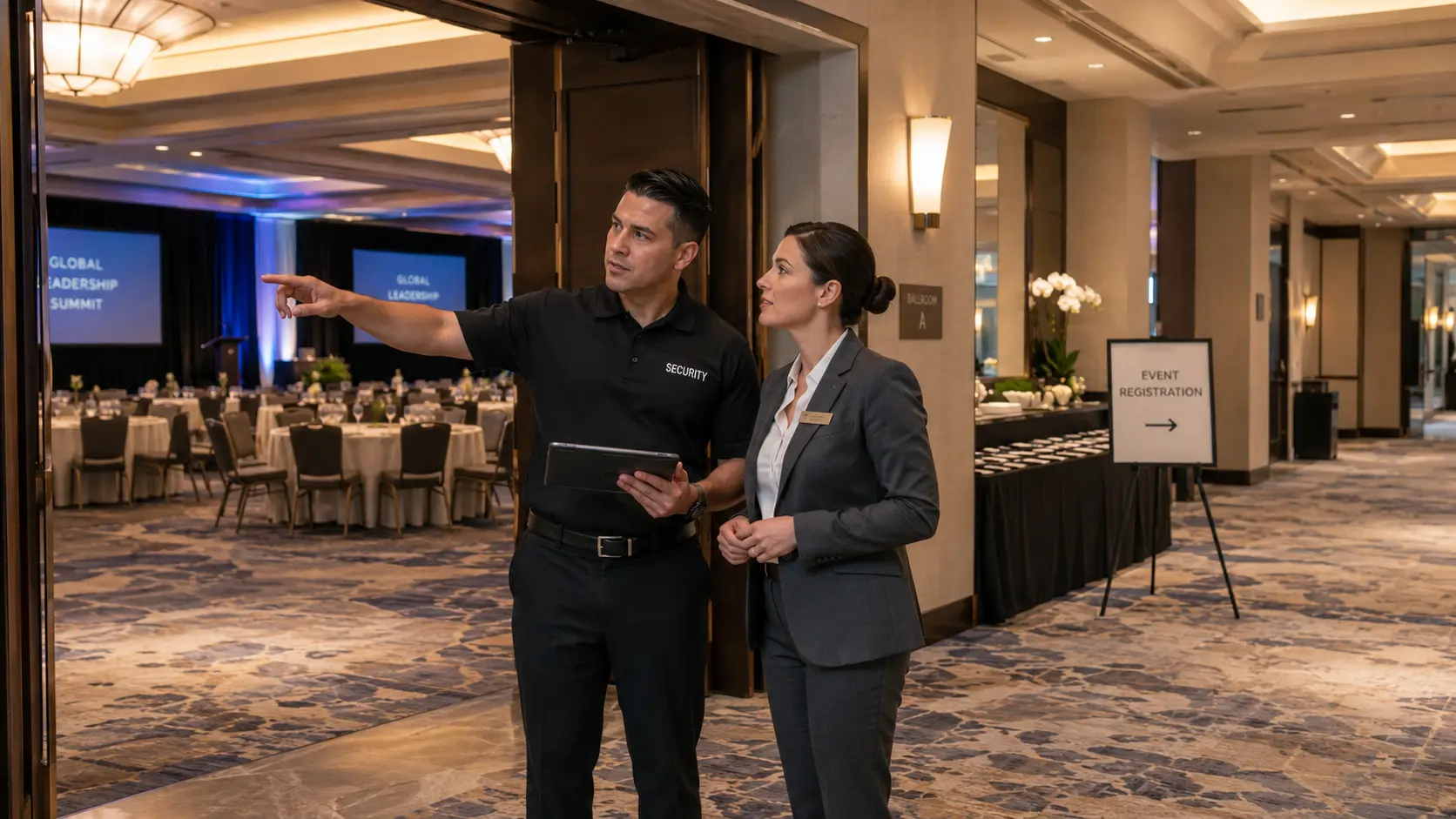
Hotel Event Security Planning: How to Protect Guests, Staff, and the Event
Hotels are designed to welcome people.
That is one of their greatest strengths—and one of their biggest security challenges.
A single hotel can contain guest rooms, restaurants, bars, meeting rooms, ballrooms, parking facilities, loading docks, employee entrances, elevators, public areas, and restricted spaces. During a major event, hundreds or even thousands of people may move through these areas within a relatively short period.
A corporate conference, wedding, awards ceremony, private party, convention, fundraiser, celebrity appearance, or other special event can temporarily transform the hotel’s normal operating environment.
That is why hotel event security should be planned as part of the event—not added at the last minute.
A professional security plan considers the event, the hotel, the expected attendees, access requirements, crowd movement, staffing, emergency procedures, communications, and the hotel’s normal operations.
The objective is not to make guests feel like they are entering a heavily guarded facility.
The objective is to create an environment where security is effective, professional, and largely unobtrusive while still providing a clear response when something goes wrong.
Why do hotel events require specialized security planning?
Hotel events are different from many other types of gatherings because the venue often serves multiple purposes simultaneously.
A hotel may have:
- Event attendees
- Overnight guests
- Hotel employees
- Vendors
- Contractors
- Restaurant customers
- Delivery personnel
- Speakers
- Performers
- VIPs
- Event organizers
- Media
- Transportation providers
Not everyone entering the property necessarily belongs to the event.
That creates an important security challenge.
A person attending a conference may need access to a ballroom but not guest floors.
A vendor may need access to a loading area but not the event itself.
A hotel guest may need unrestricted access to their room but should not automatically have access to a private event’s backstage or production area.
Effective hotel event security therefore involves more than placing guards at the front door.
It requires managing who can go where, when, and for what purpose.
Federal guidance for mass gatherings similarly emphasizes venue characteristics, existing security and emergency plans, crowd management, physical security, and coordination among stakeholders.
What is hotel event security planning?
Hotel event security planning is the process of identifying potential security and safety concerns associated with an event and establishing the personnel, procedures, technology, communications, and response measures needed to manage them.
The planning process should consider the event from setup through breakdown.
That means security does not begin when the first guest enters the ballroom.
It may begin when vendors arrive.
It may continue through:
- Setup
- Deliveries
- Registration
- Guest arrival
- Event programming
- Meal service
- Break periods
- Entertainment
- Departure
- Transportation
- Breakdown
- Vendor removal
Each phase can create different security requirements.
Start with a site-specific risk assessment
There is no universal security plan that works for every hotel event.
A 100-person corporate meeting in a controlled conference room is fundamentally different from a 2,000-person public-facing convention.
Similarly, a private wedding with alcohol service presents different operational considerations from a political conference, celebrity appearance, or high-profile corporate event.
A professional plan should therefore begin with a site-specific and event-specific risk assessment.
CISA specifically recommends site-specific physical security assessments because venues have different characteristics and vulnerabilities.
The assessment should consider factors such as:
- Expected attendance
- Event type
- Guest profile
- Event schedule
- Venue layout
- Number of entrances
- Restricted areas
- VIP attendance
- Alcohol service
- Previous incidents
- Parking arrangements
- Transportation
- Vendor access
- Crowd movement
- Security technology
- Emergency procedures
- Staffing requirements
What should be included in a hotel event risk assessment?
| Factor | Questions to Consider |
|---|---|
| Attendance | How many people are expected, and when will peak attendance occur? |
| Guest profile | Are there VIPs, public figures, executives, or other guests requiring additional consideration? |
| Venue | Which rooms, floors, entrances, parking areas, and service spaces are involved? |
| Access | Who needs access to which areas? |
| Schedule | When will arrivals, breaks, meals, entertainment, and departures create crowd movement? |
| Alcohol | Will alcohol be served, and how could that affect behavior and crowd management? |
| Vendors | Who needs access for catering, staging, equipment, deliveries, or entertainment? |
| Emergency response | How will medical, fire, evacuation, severe weather, or other emergencies be handled? |
| Communications | Who makes decisions, and how will security communicate with hotel management and event staff? |
| Existing security | What hotel security systems and personnel are already available? |
The purpose is not to predict every possible incident.
It is to identify foreseeable risks and establish reasonable procedures for managing them.
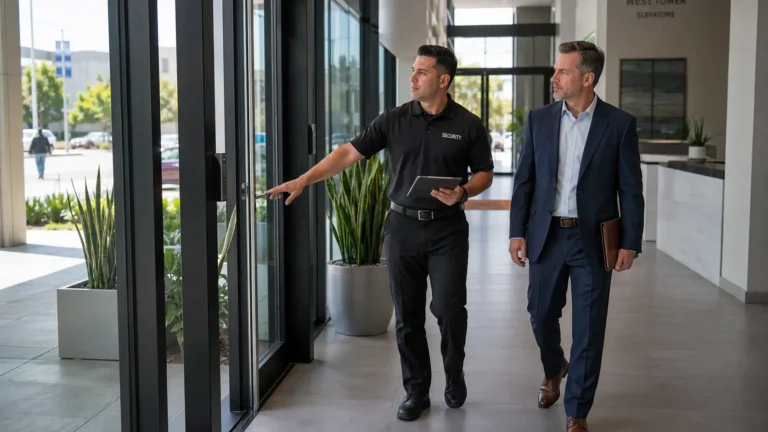
Conduct a hotel security walkthrough.
Before the event, the security team should become familiar with the actual property.
A walkthrough may examine:
- Main entrances
- Event entrances
- Ballroom entrances
- Registration areas
- Elevators
- Stairwells
- Guest floors
- Service corridors
- Loading docks
- Parking areas
- Emergency exits
- Restricted areas
- Staff entrances
- Vendor access points
- Security camera locations
- Fire and emergency access routes
This is particularly important in hotels because the event space may represent only a small portion of the property.
A security issue may occur in a parking structure, elevator lobby, loading dock, or hallway rather than inside the ballroom.
Create a clear access-control plan.
Access control is one of the most important components of hotel event security.
A good plan establishes who is allowed into each area and how that authorization will be verified.
For example:
| Area | Potentially Authorized Groups |
|---|---|
| Main event space | Registered attendees, speakers, approved staff, authorized vendors |
| VIP area | Specifically credentialed guests and assigned personnel |
| Backstage/production | Production staff, performers, authorized vendors |
| Loading dock | Approved vendors, deliveries, hotel personnel |
| Guest floors | Hotel guests, hotel staff, authorized personnel |
| Security/operations areas | Authorized hotel and security personnel |
| Restricted service areas | Hotel personnel and approved contractors |
The exact access structure should be tailored to the event.
The important principle is that not everyone needs the same level of access.
CISA guidance for public gatherings recommends defining areas requiring controlled access and using credential systems that indicate access areas and purpose.
Use credentials intelligently
Depending on the event, credentials might include:
- Event badges
- Staff credentials
- Vendor credentials
- Speaker credentials
- VIP credentials
- Media credentials
- Security identification
- Hotel employee identification
Different credentials can indicate different access permissions.
This becomes especially useful when an event occupies multiple areas of the hotel.
A credential system should also address what happens when:
- A badge is lost
- A credential is stolen
- Someone leaves the event
- A vendor’s contract ends
- An unauthorized person attempts to use someone else’s credential
- A person requests access to an area not included in their authorization
The simpler the system is for legitimate users while remaining meaningful to security personnel, the more effective it is likely to be.
Plan guest screening according to the event
Not every hotel event requires the same level of screening.
Depending on the event’s risk profile, screening may involve:
- Guest-list verification
- Credential checks
- Bag inspection
- Prohibited-item policies
- Ticket or registration verification
- Metal detection where appropriate and lawfully implemented
- Vehicle access controls
- Secondary screening procedures
Screening should be based on the event’s specific risk profile rather than automatically applying the most restrictive process possible.
A screening procedure that creates enormous queues can itself create an operational problem.
The security team should consider security effectiveness and guest experience together.
Plan for crowd movement, not just crowd size
Attendance numbers matter, but crowd movement can matter just as much.
A hotel ballroom may comfortably accommodate a certain number of people when everyone is seated.
The situation changes when hundreds of people leave simultaneously during:
- A meal break
- Conference session change
- Entertainment interval
- Emergency
- Event conclusion
Crowds can concentrate around:
- Entrances
- Registration desks
- Elevators
- Bars
- Restrooms
- Food-service areas
- Stairwells
- Parking exits
- Rideshare pickup areas
Security personnel should understand when these movement patterns are likely to occur.
Crowd management is therefore not simply about responding to disorder.
It is about anticipating predictable movement and preventing bottlenecks before they become problems.
Hotel elevators deserve special attention.
Hotels have a unique feature that many event venues do not: large numbers of people moving vertically through the building.
Elevators can become crowded during:
- Event arrival
- Meal breaks
- Event conclusion
- Late-night departures
They can also provide access to guest floors and other areas that may not be part of the event.
Depending on the hotel’s systems and event requirements, security planning may involve monitoring elevator lobbies, directing attendees toward designated event areas, or coordinating access procedures with hotel management.
The exact approach should reflect the hotel’s existing policies and capabilities.
Separate hotel guests from event attendees when necessary
One of the most delicate hotel-security challenges is maintaining normal hotel operations while a large event is taking place.
The hotel may have guests who have nothing to do with the event.
They still need to:
- Enter the hotel
- Reach their rooms
- Use elevators
- Visit restaurants
- Access parking
- Receive services
Event security should not unnecessarily interfere with legitimate hotel operations.
At the same time, event organizers may need controlled access to private meeting areas.
The solution is often layered access control rather than treating the entire hotel as either public or restricted.
Plan vendor and contractor access
Vendors can create substantial movement around a hotel event.
Examples include:
- Caterers
- Audio/visual companies
- Florists
- Entertainment providers
- Photographers
- Staging crews
- Decorators
- Equipment suppliers
- Transportation companies
Security should know which vendors are expected, what they are delivering, and where they need to go.
A delivery truck arriving at the loading dock may be legitimate.
An unidentified person claiming to be a vendor should not automatically receive the same access.
Vendor access procedures should be coordinated with hotel and event management.
Protect restricted areas
Depending on the event, restricted areas may include:
- Backstage
- Speaker preparation rooms
- VIP rooms
- Production areas
- Staff-only corridors
- Equipment storage
- Loading docks
- Cash-handling areas
- Security offices
- Certain guest floors
These areas may require dedicated security coverage or controlled access.
The objective is not to create unnecessary barriers.
It is to make sure people can enter areas appropriate to their role and authorization.
Plan for VIPs separately when necessary
A high-profile attendee can change an event’s security requirements.
VIPs may include:
- Corporate executives
- Celebrities
- Public officials
- Speakers
- High-profile guests
- Individuals with known security concerns
VIP planning may involve additional considerations regarding arrival, departure, access routes, privacy, crowd interaction, and coordination with the individual’s protection team.
The details should remain limited to personnel who genuinely need the information.
A security plan should protect sensitive information about movements, schedules, and access arrangements.
Determine the right security staffing model.
One of the most common mistakes in event planning is starting with a guard-to-attendee ratio.
There is no single number of guards that is appropriate for every hotel event.
Staffing should be based on posts, duties, risk, layout, schedule, and response requirements.
A staffing plan might include:
- Event entrance security
- Registration-area coverage
- Roving security
- Restricted-area security
- VIP-area coverage
- Parking or exterior patrol
- Loading-dock security
- Floor or corridor patrols
- Security supervisor
- Relief coverage
The number of attendees is only one variable.
A 500-person event with one controlled entrance may require a different staffing model from a 500-person event spread across several rooms and entrances.
Build the staffing plan around responsibilities.
A useful planning framework looks like this:
| Security Function | Primary Responsibility |
|---|---|
| Event entrance | Verify authorized access and observe incoming activity |
| Registration area | Support orderly entry and identify access issues |
| Roving patrol | Monitor event spaces, corridors, and designated areas |
| Restricted-area post | Prevent unauthorized access |
| VIP coverage | Support agreed VIP-security requirements |
| Exterior/parking patrol | Monitor designated exterior areas |
| Supervisor | Coordinate personnel and communicate with event/hotel management |
| Relief coverage | Maintain continuity during breaks and extended operations |
The actual assignments should be based on the venue’s layout and risk assessment.
Assign one clear security leader.
Large events can involve hotel management, event organizers, security personnel, vendors, transportation staff, and public-safety agencies.
Without a clear chain of command, information can become fragmented.
A designated security supervisor or event-security lead should know:
- Who is authorized to make operational decisions
- Who represents hotel management
- Who represents the event organizer
- How security personnel communicate
- When law enforcement or emergency services should be contacted
- Who receives incident reports
The goal is to avoid a situation where several people believe someone else is responsible for making the decision.
Establish a communications plan
Security personnel need reliable communications.
The plan may address:
- Radios
- Assigned channels
- Contact numbers
- Emergency communications
- Backup communication methods
- Supervisor communications
- Hotel management contacts
- Event-management contacts
Security personnel should know how to communicate an incident without creating unnecessary confusion.
A simple structure can be more effective than a complicated one.
Before the event begins, radios and other equipment should be tested.
Coordinate with hotel management
Hotel security does not operate independently of the hotel.
Depending on the property, coordination may involve:
- Hotel security director
- General manager
- Event/conference staff
- Engineering
- Front desk
- Housekeeping
- Food and beverage
- Valet
- Parking personnel
- Maintenance
- Emergency-response personnel
Each group may have information relevant to security.
For example, engineering may know about a door or access system that is temporarily out of service.
Event staff may know when VIPs are arriving.
Valet personnel may understand traffic patterns at the entrance.
Good security planning connects these pieces.
Plan emergency response before the event begins
A security plan should not be limited to theft, trespassing, or disorderly behavior.
Hotel events can involve a variety of emergencies.
Depending on the event and property, planning may address:
- Medical emergencies
- Fire alarms
- Evacuation
- Severe weather
- Power failure
- Suspicious packages
- Missing children or vulnerable persons
- Crowd surges
- Disorderly behavior
- Security threats
- Communication failures
CISA’s mass-gathering guidance emphasizes planning, coordination, emergency procedures, physical security, and communication as components of preparedness.
Know the evacuation routes.
Security personnel should understand:
- Primary exits
- Alternative exits
- Emergency access routes
- Areas that must remain clear
- Assembly locations identified by the venue
- Accessibility considerations
- How guests will receive instructions
The security team should coordinate with hotel management rather than improvising evacuation procedures during an emergency.
Security personnel also need to understand the boundaries of their role and follow the hotel’s emergency procedures and applicable requirements.
Medical emergencies require a plan too.
A medical incident can occur at any event.
Potential causes can include:
- Existing medical conditions
- Falls
- Heat
- Alcohol
- Food-related illness
- Dehydration
- Crowd conditions
Security personnel may be among the first people to notice a medical problem.
The plan should establish how they communicate the incident, summon appropriate medical assistance, maintain access for responders, and support the venue’s emergency procedures.
Security guards should not be expected to perform medical tasks beyond their training and authorization.
Alcohol changes the security environment
Alcohol service can affect event security planning.
It can increase the likelihood of:
- Disorderly behavior
- Arguments
- Falls
- Property damage
- Impaired driving
- Difficult interactions
The security team should understand the event’s alcohol-service arrangements and coordinate with hotel management and event staff.
The objective is not to treat every intoxicated guest as a security threat.
It is to recognize that alcohol can change crowd behavior and ensure personnel know how to respond professionally when problems develop.
Plan for parking and transportation
Event security does not end at the ballroom.
Guests may arrive through:
- Hotel parking
- Parking structures
- Valet areas
- Rideshare pickup zones
- Shuttle services
- Pedestrian entrances
These areas can become congested before and after the event.
Security planning should therefore consider:
- Vehicle flow
- Pedestrian movement
- Event arrival times
- Departure surges
- Valet operations
- Rideshare congestion
- Emergency vehicle access
A well-designed plan helps keep security and transportation operations from interfering with one another.
Use technology as a supporting layer
Hotels often already have substantial security technology.
Depending on the property, this may include:
- CCTV
- Access-control systems
- Door alarms
- Intercoms
- Emergency communications
- Visitor-management systems
- Parking systems
Technology can support security personnel, but it should not be treated as a substitute for planning.
For example, cameras can provide useful information about an event, but someone still needs to interpret the situation and determine the appropriate response.
The best approach is generally technology plus trained personnel plus clear procedures.
Conduct a pre-event briefing.
A security team should not arrive and immediately begin working without understanding the assignment.
The pre-event briefing should cover:
- Event schedule
- Venue layout
- Security posts
- Restricted areas
- Credential system
- Guest flow
- VIP considerations
- Emergency procedures
- Communications
- Reporting requirements
- Escalation procedures
- Break coverage
- End-of-event procedures
Every guard should understand what their assignment is and how it fits into the larger security plan.
Conduct a final walkthrough.
A final walkthrough shortly before guests arrive can identify last-minute changes.
For example:
- A door may be temporarily out of service
- A vendor may have changed locations
- A registration area may have moved
- A hallway may have become obstructed
- A new VIP requirement may have been added
- An entrance may be temporarily closed
Security plans should be treated as operational documents that can be adjusted when legitimate circumstances change.
What should happen if an incident occurs?
Security personnel should know the expected escalation process.
A simplified framework might be:
Observe → Assess → Communicate → Respond within authority → Escalate when necessary → Document
The exact response depends on the incident.
A minor policy violation may require a conversation with event management.
A medical emergency may require immediate medical assistance.
A serious threat may require emergency services.
The security team should not attempt to handle situations beyond its training, authority, or capabilities.
Incident documentation matters
After an incident, accurate documentation can be extremely valuable.
Reports may include:
- Date and time
- Location
- People involved
- Observed facts
- Actions taken
- Notifications made
- Witness information where appropriate
- Law-enforcement or medical response
- Outcome
Security reports should distinguish between what the guard observed and assumptions about what someone intended.
Clear documentation helps hotel management and event organizers understand what happened and determine whether procedures need to change.
Conduct a post-event security review.
The event is not finished when the last guest leaves.
A post-event review can identify:
- What worked
- What did not work
- Where crowding occurred
- Whether staffing was adequate
- Whether access controls worked
- Whether communication was effective
- Whether incidents occurred
- Whether technology performed as expected
- Whether procedures should change
For recurring hotel events, this information can improve future security planning.
A practical hotel event security timeline
| Planning Stage | Security Priorities |
|---|---|
| Initial planning | Identify event type, attendance, venue, schedule, and known risks |
| Site assessment | Walk the hotel, identify entrances, restricted areas, parking, cameras, and vulnerabilities |
| Detailed planning | Develop staffing, access control, crowd management, communications, and emergency procedures |
| Final preparation | Confirm personnel, credentials, equipment, contacts, and event changes |
| Day of event | Brief guards, conduct final walkthrough, verify posts and communications |
| During event | Monitor access, crowd movement, restricted areas, incidents, and changing conditions |
| Event conclusion | Manage departure, transportation areas, restricted access, and breakdown |
| Post-event | Complete reports, debrief personnel, review incidents, and improve the plan |
What should hotel event organizers ask a security company?
Before hiring an event-security provider, organizers should ask practical questions.
Will you conduct a site assessment?
The provider should understand the hotel’s actual layout and the event’s operational requirements.
How will you determine staffing?
The answer should involve more than a generic attendee ratio.
Who will supervise the security team?
There should be a clearly identified on-site security lead.
How will you coordinate with hotel management?
Security needs to work with the property’s existing operations.
How will access control work?
The provider should understand guest, staff, vendor, VIP, and restricted-area requirements.
How are emergencies handled?
Ask how security personnel will communicate and coordinate with the hotel’s emergency procedures and appropriate responders.
What happens after the event?
Incident reporting and a post-event review can help improve future events.
Common hotel event security mistakes
Waiting until the last minute
Security planning becomes much harder when the event is only days away.
Starting with a guard count
The number of guards should follow the security requirements, not the other way around.
Ignoring hotel operations
Event attendees are not the only people using the property.
Treating every area equally
Some areas require substantially more security attention than others.
Failing to control vendor access
Vendors may have legitimate reasons to access restricted areas, but that access should still be controlled.
Overlooking event departure
Large numbers of guests leaving simultaneously can create significant crowd and transportation challenges.
Having no clear command structure
Everyone should know who is responsible for security decisions.
Assuming technology solves everything
Cameras and access-control systems are valuable tools, but they do not replace people, planning, or response procedures.
The goal is security without unnecessary disruption
Hotel event security should protect people without making legitimate guests feel as though they are entering a restricted facility.
That requires balance.
Security personnel need to be visible enough to deter problems and respond quickly, but professional enough to maintain the atmosphere appropriate to the event.
A wedding, corporate conference, awards ceremony, or private reception should still feel like the event the organizer intended to create.
Good security operates in the background until it is needed.
The bottom line
Hotel event security planning is not simply about putting guards at entrances.
It is a coordinated process that considers the hotel’s physical environment, event characteristics, guest movement, access requirements, staffing, communications, emergency procedures, technology, vendors, and normal hotel operations.
The strongest plans are site-specific and risk-based.
They begin with an assessment rather than a predetermined number of guards.
They establish clear responsibilities.
They control access without unnecessarily disrupting legitimate hotel activity.
They anticipate crowd movement.
They prepare for emergencies.
They coordinate hotel management, event organizers, security personnel, vendors, and appropriate public-safety partners.
And they continue after the event through incident reporting and post-event review.
For hotels and event organizers, the most important principle is simple:
Security should be planned before the event, not improvised when something goes wrong.
A professional security provider can help translate the event schedule, venue layout, attendance, access requirements, and identified risks into a practical security operation designed around the property’s actual needs.
Frequently Asked Questions
How early should hotel event security planning begin?
The appropriate lead time depends on the size, complexity, and risk profile of the event. Larger or more complex events generally require more advance coordination because staffing, access control, emergency planning, vendors, hotel operations, and other stakeholders need time to align.
How many security guards does a hotel event need?
There is no universal number. Staffing should be based on attendance, venue layout, entrances, restricted areas, crowd movement, event schedule, risk factors, required duties, and response requirements.
Should hotel event security include the entire hotel?
Not necessarily. Security coverage should correspond to the event and property. However, planners should consider how event activity interacts with guest floors, elevators, parking, loading areas, restaurants, and other hotel operations.
Should event attendees have access to hotel guest floors?
Not automatically. Access should follow the hotel’s policies and the event’s requirements. Event credentials should generally provide only the access necessary for the person’s role.
Do hotel events need security at the entrance?
Many events benefit from controlled entry, but the appropriate approach depends on the event. Entrance security may involve registration verification, credential checks, guest-list management, screening, or simply maintaining an orderly entry environment.
Does alcohol affect event security planning?
Yes. Alcohol service can influence crowd behavior and should be considered when planning staffing, monitoring, incident response, and coordination with hotel and event personnel.
Should VIP guests have a separate security plan?
High-profile guests may require additional planning depending on their circumstances and the event. VIP arrangements should be coordinated with the appropriate protection personnel, hotel management, and event organizers while limiting sensitive information to those who need it.
Does hotel event security include parking?
It can and often should, particularly when parking, valet, rideshare, or shuttle operations are part of the event experience. Security requirements should be based on the property’s layout and event-specific risks.
Should security guards monitor the event after guests leave?
Security requirements can continue through guest departure, vendor breakdown, and other post-event activities. The appropriate end time should be established in the event security plan.
Can hotel security use cameras and AI?
Hotels can use surveillance, access-control, and other technologies as part of a layered security strategy. Technology should support trained personnel and established procedures rather than being treated as a complete replacement for human security.
What should happen after a security incident?
The appropriate response depends on the incident. Security personnel should follow established procedures, notify the appropriate hotel and event contacts, request emergency assistance when necessary, document relevant facts, and participate in a post-event review.
Is a security site survey useful for hotel events?
Yes. A site-specific assessment can help identify entrances, restricted areas, crowd-flow challenges, surveillance limitations, parking concerns, emergency routes, and other property-specific considerations before the event begins. CISA recommends a site-specific physical security assessment as part of venue security planning.