📞
BSIS PPO License: 122365
+1 (818) 966-2279
✉️
Sahnaz@workforcesecurityservices.com
What Happens During a Professional Security Site Survey?
Before a professional security company recommends guards, patrols, cameras, access-control procedures, or other protective measures, it needs to understand the property it is being asked to protect.
That is the purpose of a security site survey.
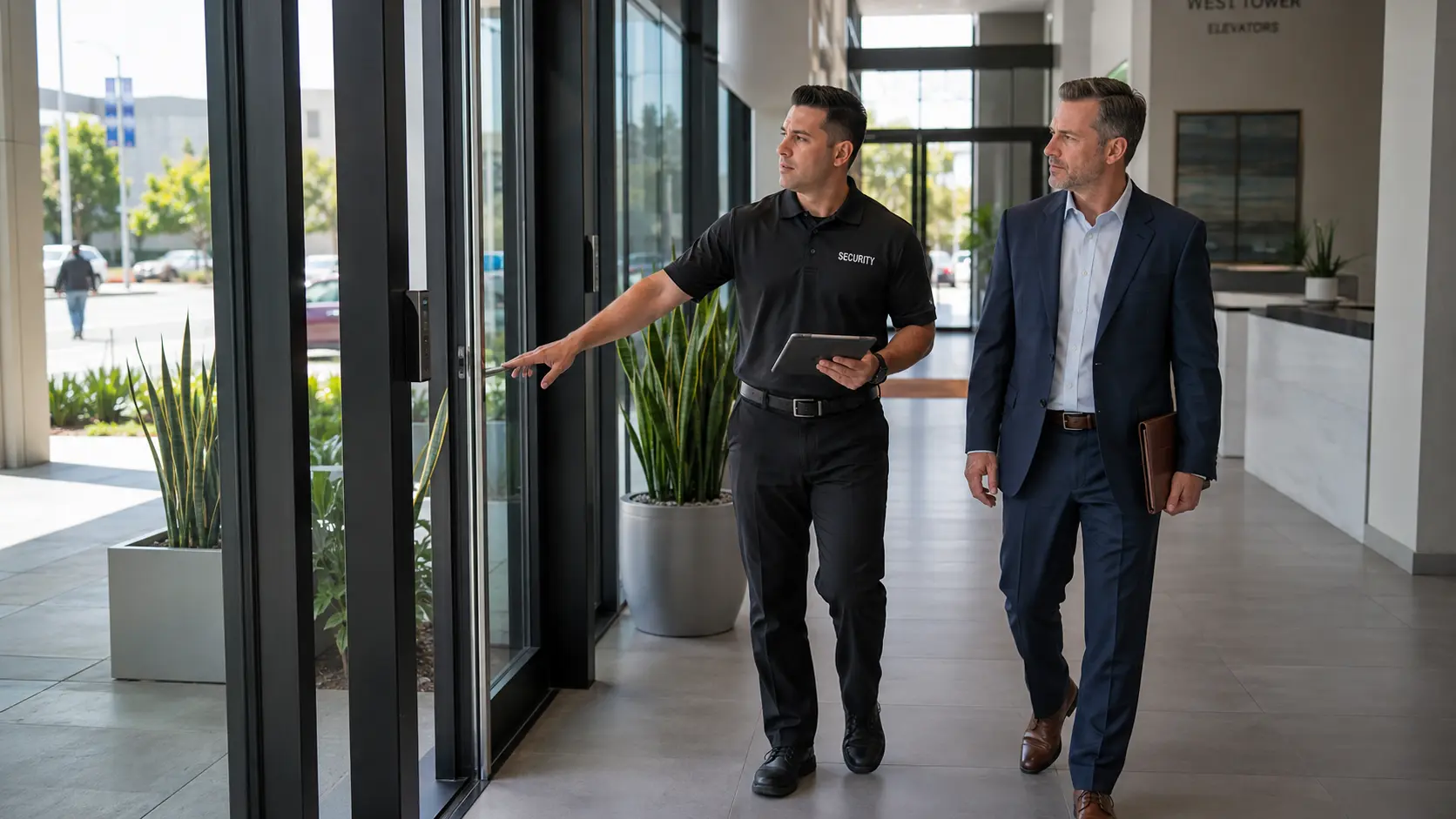
A professional security site survey is a structured assessment of a property’s physical environment, operations, vulnerabilities, existing security measures, and potential risks. It allows a security provider to develop recommendations based on the actual conditions at the site rather than relying on a generic security package.
For a business owner or property manager, the process may appear simple from the outside. A security professional walks through the property, asks questions, examines entrances and exits, and provides recommendations.
In reality, a thorough site survey involves much more.
The objective is to answer a fundamental question:
What security risks does this property face, and what combination of people, procedures, and technology is appropriate for managing them?
What is a security site survey?
A security site survey is an on-site evaluation conducted to identify security risks, vulnerabilities, existing protective measures, and opportunities for improvement.
Depending on the property, the assessment may examine:
- Buildings and structures
- Entrances and exits
- Parking areas
- Perimeters
- Lighting
- Access-control points
- Loading areas
- Employee entrances
- Visitor access
- Security cameras
- Alarm systems
- Existing guards
- Emergency procedures
- High-value areas
- Crime and incident history
- Operational routines
- Environmental conditions
The survey is not simply a walk-through.
A good assessment considers how the property actually operates.
A warehouse, apartment community, retail store, construction site, office building, and medical facility can have completely different security requirements even if they are located in the same neighborhood.
Why do security companies conduct site surveys?
The primary reason is to avoid designing security based on assumptions.
A business might initially request “one security guard,” for example.
But after examining the property, a security professional may determine that one stationary guard at the main entrance would leave another entrance, parking area, loading dock, or perimeter vulnerable.
Conversely, a business may believe it needs multiple guards when better access control, improved lighting, cameras, or revised procedures could reduce the need for continuous physical coverage.
The survey allows the provider to evaluate the actual problem before recommending a solution.
What happens before the security professional arrives?
A professional site survey often begins before anyone steps onto the property.
The security provider may gather preliminary information about the business, such as:
- Property type
- Size and layout
- Operating hours
- Number of employees
- Number of visitors
- Current security staffing
- Previous security incidents
- Theft or vandalism concerns
- Existing surveillance
- Access-control systems
- Emergency procedures
- Known problem areas
The security professional may also review information provided by the client regarding previous incidents or specific concerns.
For example, a property manager might explain that unauthorized individuals frequently enter through a particular gate after business hours.
That information gives the security professional a specific issue to investigate during the site visit.
Does the security professional walk the entire property?
Ideally, yes.
The extent of the walkthrough depends on the size and complexity of the property.
A small retail business may take relatively little time to inspect.
A large commercial campus, construction project, warehouse, apartment community, or industrial facility can require considerably more attention.
The survey may cover both interior and exterior areas.
A professional should not evaluate only the most visible part of the property.
Security vulnerabilities often exist in places that receive less attention, such as:
- Rear doors
- Side entrances
- Loading docks
- Parking structures
- Service corridors
- Fences and gates
- Emergency exits
- Rooftop access
- Storage areas
- Trash and recycling areas
- Dark areas
- Isolated employee entrances
What does a security professional look for?
The survey typically examines the property’s attack surface—the locations and conditions through which unauthorized access, theft, vandalism, violence, or other incidents could occur.
The exact checklist varies by property, but common considerations include:
Entrances and exits
The security professional examines how people enter and leave the property.
Questions may include:
- How many entrances are there?
- Which entrances are open to the public?
- Which are restricted?
- Are employee entrances separately controlled?
- Can unauthorized people enter unnoticed?
- Are doors routinely propped open?
- Are access credentials required?
- Are exits adequately monitored?
The goal is to understand where access can be controlled and where it may be vulnerable.
Perimeter
For properties with significant outdoor space, perimeter security can be critical.
The survey may examine:
- Fences
- Gates
- Walls
- Vehicle entrances
- Pedestrian access
- Gaps or damaged sections
- Adjacent properties
- Areas that are difficult to observe
- Vegetation or structures that obstruct visibility
A security professional may also consider how easily someone could approach the property without being noticed.
Parking areas
Parking lots and garages can present different security challenges from the main building.
The survey may evaluate:
- Lighting
- Camera coverage
- Pedestrian routes
- Vehicle entrances
- Stairwells
- Elevators
- Isolated areas
- Blind spots
- After-hours activity
- Employee parking
- Visitor parking
For businesses that operate at night, parking-area security can be particularly important because employees and customers may spend significant time outside the building.
What about lighting?
Lighting is a fundamental part of physical security.
During a survey, the security professional may identify areas that are poorly illuminated or where lighting creates shadows and visibility problems.
The assessment may consider:
- Building entrances
- Parking lots
- Walkways
- Perimeters
- Loading areas
- Stairwells
- Service entrances
- Emergency exits
The objective is not simply to make a property brighter.
Lighting should support visibility, surveillance, and safe movement.
In some cases, improving lighting may be a relatively straightforward way to address a vulnerability without adding additional guard hours.
How are security cameras evaluated?
If the property already has CCTV or video surveillance, the site survey may evaluate how effectively the system supports the security objectives.
A security professional may examine:
- Camera locations
- Coverage
- Blind spots
- Image quality
- Lighting conditions
- Entrance coverage
- Perimeter coverage
- Recording capability
- Camera positioning
- Monitoring procedures
- Retention practices
A property can have many cameras and still have inadequate coverage.
The number of cameras alone does not determine how effective a surveillance system is.
A camera pointed at the wrong angle, obstructed by an object, or poorly positioned in relation to lighting may provide little useful evidence.
Does the survey include access control?
Yes.
Access control is often one of the most important parts of a security assessment.
The security professional may examine:
- Key systems
- Electronic access cards
- Keypads
- Turnstiles
- Visitor management
- Employee identification
- Delivery access
- Contractor access
- Restricted areas
- After-hours access
- Lost credentials
- Door alarms
The survey may also examine whether access procedures are actually being followed.
A sophisticated access-control system provides limited protection if employees routinely allow unauthorized people to follow them through controlled doors.
How are employees and visitors considered?
Security is not only about the physical property.
People are a major part of the security environment.
A site survey may examine how employees, customers, contractors, vendors, and visitors move through the property.
For example:
- Where do visitors check in?
- Who is authorized to admit them?
- Are visitors issued badges?
- How are contractors verified?
- Who can access restricted areas?
- How are deliveries handled?
- What happens when an employee loses an access credential?
- How are former employees removed from access systems?
Understanding these processes can reveal vulnerabilities that are invisible during a simple physical inspection.
Does the security survey examine previous incidents?
A good survey should consider the property’s history.
The security professional may ask about:
- Theft
- Burglary
- Vandalism
- Trespassing
- Unauthorized access
- Workplace violence
- Employee misconduct
- Parking incidents
- Customer disturbances
- Package theft
- Property damage
- Emergency incidents
Incident history can reveal patterns.
For example, if theft repeatedly occurs during a particular shift, near a particular entrance, or in a specific area, the security solution may need to address that pattern rather than simply increase security everywhere.
Does location matter?
Yes.
A security assessment should consider the property’s surrounding environment.
For a Los Angeles business, this may include factors such as:
- Nearby commercial activity
- Adjacent properties
- Public access points
- Traffic patterns
- Parking conditions
- Transit access
- Surrounding land use
- Previous incidents in the immediate area
However, location should not be treated as a substitute for evaluating the actual property.
Two businesses on the same street can have very different security risks because of differences in layout, operating hours, staffing, access points, inventory, and customer traffic.
Are employees interviewed during a site survey?
Sometimes.
Depending on the assignment, the security professional may speak with managers, employees, facilities personnel, or other people who understand the property’s daily operations.
Employees can identify issues that may not be obvious during a short walkthrough.
For example, employees may know that:
- A particular door frequently fails to close
- A parking area becomes empty late at night
- A delivery entrance is routinely left open
- Visitors sometimes bypass reception
- Certain equipment attracts repeated theft
- A particular area becomes difficult to monitor during shift changes
Operational knowledge can be extremely valuable.
What is a vulnerability assessment?
A vulnerability assessment examines weaknesses that could make the property more susceptible to security incidents.
A vulnerability might involve:
- Poor visibility
- Uncontrolled access
- Inadequate staffing
- Weak procedures
- Insufficient lighting
- Camera blind spots
- Unsecured doors
- Poor perimeter protection
- Inadequate emergency communication
- Lack of incident documentation
The important point is that vulnerabilities are not limited to physical structures.
People, procedures, and technology can all create vulnerabilities.
What is a risk assessment?
Risk and vulnerability are related but not identical.
A vulnerability is a weakness.
Risk considers the likelihood and potential consequences of something happening.
For example, a rear gate that does not lock properly is a vulnerability.
If that gate provides direct access to a high-value storage area, the resulting security risk may be considerably greater than if the same gate leads to an empty section of a property.
Professional security planning therefore considers both the weakness and its potential consequences.
How does a site survey determine the number of security guards needed?
There is no universal formula such as “one guard per 10,000 square feet.”
The appropriate staffing level depends on the assignment.
The security professional may consider:
- Property size
- Number of entrances
- Operating hours
- Traffic volume
- Security incidents
- Patrol requirements
- Required response time
- Number of buildings
- Parking areas
- Perimeter
- Risk level
- Client procedures
- Guard duties
- Break coverage
- Emergency requirements
For example, one guard may be appropriate for a small facility with a controlled entrance and limited after-hours activity.
A large property with multiple buildings and extensive perimeter requirements may need multiple guards, mobile patrols, or a combination of fixed and mobile coverage.
The survey provides the information needed to make that decision.
Does a site survey always result in more security guards?
No.
A professional security assessment should not be designed simply to justify selling more guard hours.
Sometimes the survey may show that additional personnel are appropriate.
But it may also identify opportunities to improve security through:
- Better lighting
- Improved locks
- Access-control changes
- Camera repositioning
- Visitor-management procedures
- Revised patrol routes
- Better employee procedures
- Alarm improvements
- Physical barriers
- Technology
- Changes to operating procedures
The best security solution is not necessarily the most expensive one.
Can technology reduce the need for guards?
Sometimes.
A site survey may identify tasks that can be supported by technology.
Examples include:
- AI-assisted video analytics
- Access-control systems
- Intrusion detection
- Automatic gates
- License-plate recognition
- Remote video monitoring
- Alarm systems
- Intercoms
- Environmental sensors
But technology should be selected based on the actual security requirements.
A camera can detect an event.
It cannot necessarily physically intervene.
An access-control system can prevent an unauthorized credential from opening a door.
It may not be able to deal with someone following an authorized employee through that door.
A site survey helps determine where technology and human personnel can complement one another.
How does the security company evaluate patrol routes?
For mobile or foot patrol assignments, the survey may identify the areas that require regular observation and determine how a guard can move efficiently through the property.
The assessment can consider:
- High-risk areas
- Low-visibility locations
- Parking areas
- Perimeter
- Entrances
- Loading docks
- Equipment areas
- Storage areas
- Emergency exits
The goal is not simply to have a guard walk around randomly.
Patrols should have a defined purpose and should provide meaningful coverage.
What happens with emergency procedures?
A security site survey may also examine how the property responds to emergencies.
Depending on the assignment, this can include:
- Fire
- Medical emergencies
- Workplace violence
- Unauthorized entry
- Severe weather
- Power outages
- Evacuations
- Suspicious packages
- Other emergencies relevant to the property
The security professional may evaluate communication methods, emergency access, evacuation routes, assembly areas, and coordination with emergency responders.
Security personnel should know what they are expected to do—and what they are not authorized or trained to do.
Is the survey focused only on preventing crime?
No.
A comprehensive security assessment should consider a broader range of threats.
Depending on the property, these may include:
- Theft
- Burglary
- Trespassing
- Vandalism
- Workplace violence
- Unauthorized access
- Property damage
- Fire-related risks
- Medical emergencies
- Safety hazards
- Operational disruptions
Security planning should reflect the actual risks faced by the property rather than focusing exclusively on crime.
What happens after the walkthrough?
The security professional typically analyzes the information collected during the site visit.
The resulting recommendations may address:
- Guard staffing
- Patrol frequency
- Post locations
- Access control
- Surveillance
- Lighting
- Alarm systems
- Visitor procedures
- Emergency response
- Incident reporting
- Employee procedures
- Technology
- Physical security improvements
The recommendations should be connected to identified risks.
A professional report should make it reasonably clear why a particular measure is being recommended.
What should a security survey report contain?
The format varies between security companies and assignments, but a useful report may include:
- Property overview
- Security objectives
- Existing security measures
- Identified vulnerabilities
- Incident history
- Recommended guard coverage
- Patrol recommendations
- Access-control observations
- Surveillance observations
- Lighting observations
- Emergency-response considerations
- Recommended procedures
- Technology recommendations
- Prioritized improvements
For larger properties, diagrams, photographs, maps, or other supporting documentation may also be useful.
Should businesses receive a copy of the site survey?
That depends on the security provider and the nature of the assessment.
Businesses should understand what deliverables are included before commissioning the survey.
A client may receive a formal written report, an executive summary, recommendations, a staffing proposal, or another form of assessment.
Businesses should also be careful about how detailed security information is distributed internally.
A document identifying vulnerabilities, camera blind spots, access weaknesses, or security procedures can itself contain sensitive information.
Access to detailed security assessments should therefore be controlled appropriately.
How often should a business conduct a security site survey?
There is no universal schedule that applies to every business.
A property may benefit from another assessment when there is a significant change in:
- Building layout
- Ownership
- Tenancy
- Operating hours
- Staffing
- Security incidents
- Access-control systems
- Surveillance systems
- Construction
- Business operations
- Risk profile
A major renovation, expansion, new tenant, repeated security incident, or change in operating conditions may justify reassessing the property.
Even without a major change, periodic review can help identify vulnerabilities that develop over time.
What should businesses ask a security company before a site survey?
Before hiring a provider, business owners should ask:
Who will conduct the survey?
Ideally, the person should have relevant security experience and understand the type of property being assessed.
What will the survey cover?
Ask whether the assessment includes physical security, staffing, technology, procedures, emergency response, and other relevant areas.
Will recommendations be prioritized?
A long list of vulnerabilities is less useful than a clear explanation of which issues deserve immediate attention.
Will the survey include guard staffing recommendations?
If the purpose is to develop a guard-service proposal, the assessment should explain how the recommended staffing level was determined.
Will technology be considered?
A professional assessment should consider whether cameras, access control, alarms, or other technologies can complement physical security.
Will the assessment account for our operating hours and business processes?
Security requirements can change significantly between business hours and overnight operations.
What are the biggest mistakes businesses make?
One of the biggest mistakes is treating security as a commodity.
A business may compare security companies based primarily on hourly rates.
But the lowest hourly rate does not necessarily produce the best security outcome.
Another mistake is requesting a specific number of guards before determining what the guards actually need to accomplish.
For example:
“We need two guards.”
The more useful question is:
“What security functions need to be performed, where do they need to happen, and how quickly must a guard respond?”
That approach produces a much more meaningful security plan.
What should a professional security site survey ultimately accomplish?
A site survey should give the business a clearer understanding of its security environment.
It should answer questions such as:
- What are our most significant vulnerabilities?
- Where are they located?
- What incidents are most likely?
- What consequences could result?
- What existing controls are effective?
- Where are the gaps?
- How much human security is appropriate?
- What technology would provide meaningful value?
- What procedures need improvement?
- Which improvements should be implemented first?
The result should be a security strategy that is proportionate to the property’s actual needs.
The bottom line
A professional security site survey is much more than a walkthrough before a security company provides a price.
It is the foundation for determining how a property should be protected.
A thorough assessment looks at the physical environment, people, procedures, technology, operating conditions, previous incidents, vulnerabilities, and potential risks.
For a Los Angeles business, that could mean evaluating everything from storefront entrances and parking areas to employee access, loading docks, surveillance coverage, and after-hours operations.
The goal is not necessarily to add more guards.
The goal is to determine what combination of security personnel, technology, procedures, and physical measures provides an appropriate level of protection for the property.
When a security plan begins with a proper site survey, businesses are in a much better position to understand what they are paying for, why particular security measures have been recommended, and where those measures can make the greatest difference.
Frequently Asked Questions
What is a professional security site survey?
A professional security site survey is an on-site assessment of a property’s security risks, vulnerabilities, existing security measures, operations, and potential improvements. It is used to develop an appropriate security strategy.
How long does a security site survey take?
There is no standard duration. A small retail property may be assessed relatively quickly, while a large commercial facility, construction site, apartment community, or industrial property may require considerably more time.
Is a security site survey the same as a security risk assessment?
The terms are sometimes used differently by security companies. A site survey generally focuses on evaluating the physical property and its security conditions, while a broader risk assessment may also examine threats, likelihood, consequences, procedures, and organizational factors.
Does every business need a security site survey?
A site survey can be particularly valuable when a business is hiring security for the first time, changing providers, responding to security incidents, expanding its property, or reassessing its security program.
Will a security site survey tell me how many guards I need?
It can help determine an appropriate staffing level by examining the property’s size, operating conditions, access points, patrol requirements, risks, and required response times. There is no universal guard-to-square-foot ratio.
Can a site survey reduce my security costs?
Potentially. A professional assessment may identify inefficient guard deployment or opportunities to use procedures and technology more effectively. The objective should be to achieve appropriate protection rather than simply maximize the number of guard hours.
Does a security site survey include cameras?
It can. Depending on the assignment, the survey may examine camera locations, coverage, blind spots, image quality, monitoring procedures, and whether the surveillance system supports the property’s security objectives.
Does a site survey include lighting?
A thorough physical-security assessment should consider lighting where visibility affects security or safety, including entrances, parking areas, walkways, loading zones, and perimeter areas.
Should a business conduct another survey after a security incident?
It may be appropriate, particularly if the incident reveals a vulnerability that was not previously identified or if the business’s risk profile has changed.
Can AI and other technology be included in a security site survey?
Yes. A modern security assessment can consider AI-assisted video analytics, access control, intrusion detection, remote monitoring, alarms, and other technologies where they are appropriate for the property’s needs.
What should I do with the results of a security site survey?
The recommendations should be prioritized according to risk, urgency, cost, and operational impact. Businesses do not necessarily need to implement every recommendation at once. High-priority vulnerabilities should generally receive the most immediate attention.
A note about security assessments
A security site survey provides general operational guidance and should be tailored to the specific property and its risks. Security conditions can change as buildings, tenants, staffing, technology, and business operations change.
Businesses should also ensure that security recommendations comply with applicable laws, regulations, building requirements, privacy obligations, and emergency procedures.