📞
BSIS PPO License: 122365
+1 (818) 966-2279
✉️
Sahnaz@workforcesecurityservices.com
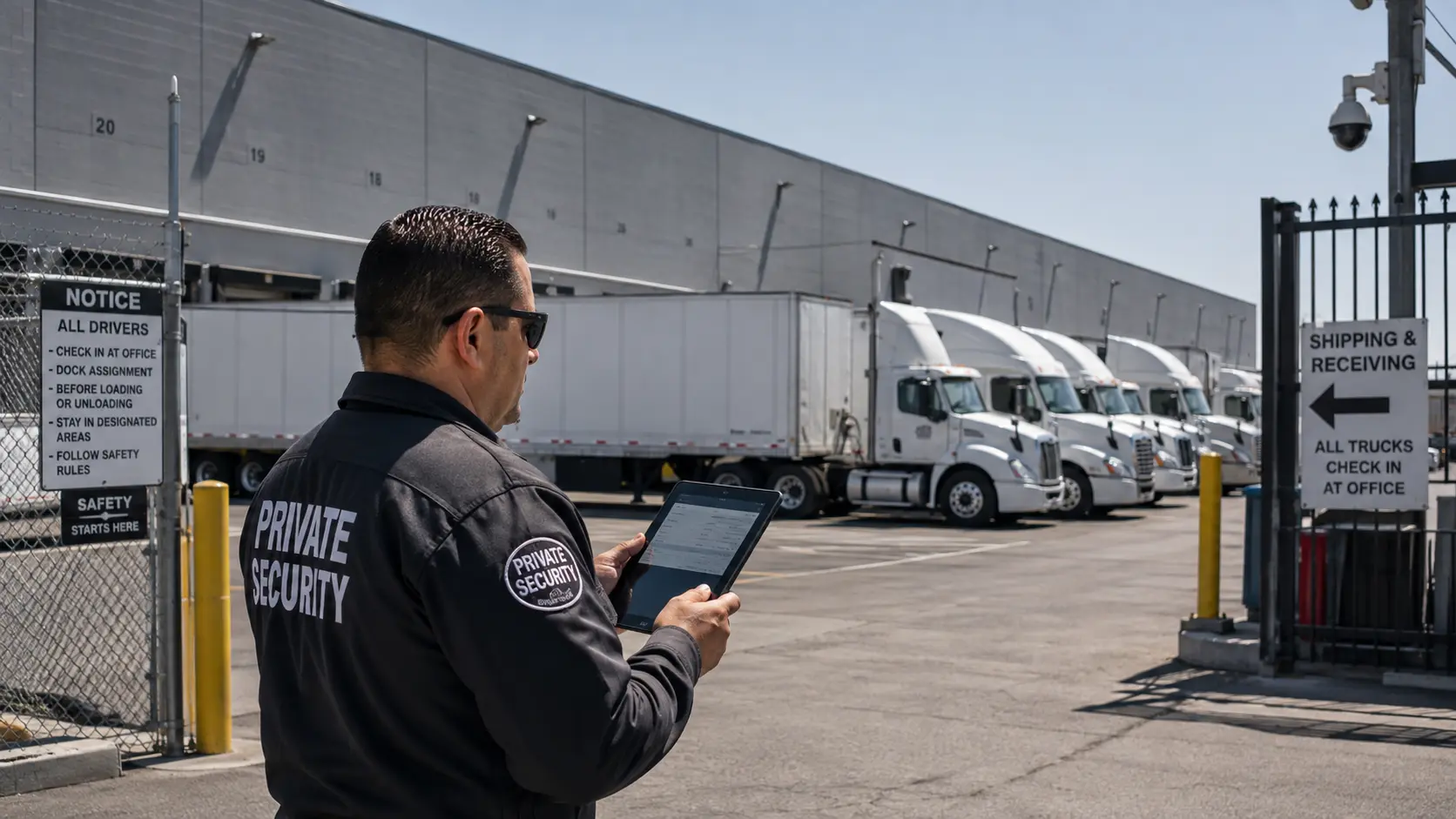
Preventing Cargo Theft: Practical Security Strategies for Businesses
Cargo theft is a serious security and operational problem for businesses that move, store, or receive valuable goods.
The losses can extend well beyond the value of the stolen merchandise. A cargo theft can disrupt deliveries, delay customers, create insurance and administrative costs, expose weaknesses in supply-chain operations, and damage a company’s reputation.
For businesses in Los Angeles and throughout California, the challenge can be particularly complex because cargo may move through warehouses, distribution centers, trucking facilities, parking areas, ports, rail facilities, and other transportation hubs before reaching its destination.
The good news is that cargo theft is not simply a problem to deal with after a shipment disappears.
Businesses can reduce exposure by combining physical security, access control, employee procedures, technology, driver verification, and well-planned security operations.
The most effective strategy is usually layered. No single guard, camera, gate, or tracking system can eliminate every risk.
What is cargo theft?
Cargo theft generally refers to the theft of goods while they are being transported, stored, loaded, unloaded, or otherwise handled within the supply chain.
Cargo can be stolen from:
- Trucks
- Trailers
- Warehouses
- Distribution centers
- Loading docks
- Storage yards
- Parking areas
- Freight facilities
- Staging areas
The cargo itself can vary considerably. High-value electronics, pharmaceuticals, food and beverages, consumer products, metals, clothing, automotive components, and other commercially valuable goods can all be targets.
Cargo theft also does not necessarily involve someone simply breaking into a locked trailer.
Criminals may exploit weaknesses in transportation procedures, documentation, identity verification, access control, or shipment information.
That is why preventing cargo theft requires attention to the entire logistics process, not just the physical perimeter.
Why is cargo theft difficult to prevent?
Cargo frequently moves through multiple locations and involves multiple organizations.
A typical shipment may involve:
- Shipper
- Warehouse
- Carrier
- Driver
- Distribution facility
- Transportation provider
- Receiver
Each transition creates another opportunity for information to be misunderstood, credentials to be misused, or physical security controls to fail.
The challenge is therefore partly physical and partly procedural.
A facility can have excellent fencing and cameras but still experience theft if unauthorized individuals can obtain shipment information or gain access through weak verification procedures.
What are the most important cargo-theft risks?
The exact risks vary by business, but common vulnerabilities include:
| Risk Area | Potential Security Problem |
|---|---|
| Perimeter | Unauthorized entry into yards or loading areas |
| Access control | Individuals entering without proper authorization |
| Loading docks | Cargo removed during loading or unloading |
| Parking | Trucks or trailers left unattended |
| Driver verification | Unauthorized person presenting as an expected driver |
| Documentation | False or manipulated shipment information |
| Insider access | Employees or contractors misusing legitimate access |
| Surveillance | Camera blind spots or inadequate monitoring |
| Shipment information | Sensitive cargo details reaching unauthorized people |
| After-hours operations | Reduced staffing or supervision |
The purpose of a security assessment is to determine which of these risks are actually relevant to a particular facility or operation.
Start with a cargo-security risk assessment.
Before adding guards or technology, businesses should understand where their greatest exposure exists.
A professional security assessment can examine:
- Property layout
- Cargo value
- Shipment volume
- Operating hours
- Loading procedures
- Driver access
- Employee access
- Trailer storage
- Parking arrangements
- Perimeter security
- Lighting
- CCTV coverage
- Access-control systems
- Previous theft incidents
- Delivery and pickup procedures
- Emergency response
The assessment should also consider when cargo is most vulnerable.
For example, a warehouse may have different risks while trucks are actively loading compared with overnight periods when trailers remain parked.
Protect the perimeter
A strong physical perimeter is one of the first layers of cargo security.
Depending on the facility, security measures can include:
- Fencing
- Controlled gates
- Vehicle barriers
- Secure pedestrian entrances
- Adequate lighting
- CCTV
- Intrusion detection
- Guard patrols
- Controlled visitor access
The objective is not simply to make unauthorized entry difficult.
The perimeter should also make unauthorized activity visible and detectable.
Secure vehicle and trailer access
Cargo security does not end at the building entrance.
Trucks and trailers may remain vulnerable while parked on the property.
Businesses should establish clear procedures for:
- Where trucks may park
- Where trailers may be staged
- Who can access trailers
- How trailer status is recorded
- How vehicles are identified
- How unauthorized movement is handled
Where appropriate, security personnel can monitor vehicle movement and verify that vehicles entering or leaving the property correspond to authorized activity.
Control access to loading docks
Loading docks can become busy environments involving employees, drivers, contractors, forklifts, visitors, and delivery personnel.
That activity can make unauthorized access harder to notice.
Businesses should establish procedures for:
- Driver identification
- Delivery appointments
- Pickup authorization
- Loading-area access
- Visitor management
- Documentation
- Trailer access
- Completion of loading or unloading
The more valuable the cargo, the more important it becomes to establish clear responsibility for who is authorized to access it.
Verify drivers and carriers.
Driver and carrier verification can be an important part of cargo-security procedures.
The objective is to establish that the person and vehicle arriving for a pickup or delivery are actually associated with the expected shipment.
Depending on the operation, verification may involve:
- Driver identification
- Carrier information
- Vehicle information
- Trailer information
- Appointment information
- Shipment documentation
- Dispatch information
- Confirmation with the appropriate company contact
The exact process should be established by the business and transportation partners.
Security personnel should follow the facility’s approved verification procedures rather than improvising their own standards.
Do not rely on one piece of information.
A professional verification process can use multiple pieces of information.
For example, a business may compare the expected carrier, appointment, driver information, vehicle information, and shipment details rather than relying on a single document.
This is an important security principle:
One matching detail does not necessarily establish that an entire transaction is legitimate.
The appropriate level of verification depends on the shipment, facility, and operating procedures.
Protect shipment information
Cargo thieves do not necessarily need to break through a fence if they can obtain information that makes the cargo easier to target.
Businesses should therefore consider who has access to information such as:
- Shipment contents
- Cargo value
- Pickup times
- Delivery schedules
- Vehicle information
- Customer information
- Warehouse locations
- Security procedures
Access to sensitive logistics information should be limited to people who need it for legitimate business purposes.
Employees and contractors should also understand why protecting shipment information matters.
Use cameras strategically
CCTV can be an important layer of cargo security.
But simply installing cameras is not enough.
A professional security assessment should consider whether cameras effectively cover:
- Vehicle entrances
- Gates
- Loading docks
- Trailer storage
- Parking areas
- Pedestrian entrances
- High-value storage areas
- Building entrances
- Perimeter areas
Camera placement should also take into account lighting, obstructions, viewing angles, image quality, and the purpose of the surveillance.
A camera that records an incident from too far away to identify useful details may have limited value.
Consider active monitoring
Recorded video can be valuable after a theft.
Active monitoring can potentially provide another layer by allowing security personnel to identify suspicious activity while it is occurring.
Depending on the operation, monitoring may be performed by:
- On-site security personnel
- A security operations center
- Remote video-monitoring personnel
- Designated facility staff
AI-assisted video analytics can also help identify certain predefined events or unusual activity, but these systems should be treated as tools that support human decision-making rather than as infallible theft detectors.
Improve lighting
Poor lighting can make it easier for unauthorized activity to go unnoticed.
Businesses should evaluate lighting around:
- Loading docks
- Gates
- Parking areas
- Trailer storage
- Building entrances
- Perimeters
- Pedestrian routes
Lighting should support both security monitoring and safe movement for employees and drivers.
It should also be maintained.
A security system can become less effective when lights fail, and nobody is responsible for identifying the problem.
Reduce unnecessary trailer dwell time.
The longer valuable cargo remains unattended, the greater the opportunity for theft.
Businesses should evaluate how long loaded trailers remain:
- At the warehouse
- In staging areas
- In parking lots
- At transfer locations
- At other intermediate points
Operational efficiency can therefore contribute to physical security.
Reducing unnecessary dwell time can remove opportunities for cargo to remain exposed.
Secure high-value cargo appropriately
Not all cargo requires the same security measures.
A facility may use different controls for:
- Ordinary inventory
- High-value goods
- Controlled products
- Sensitive shipments
- Frequently targeted commodities
High-value goods may warrant additional access restrictions, surveillance, inventory controls, or physical protection.
The objective should be proportionate security, rather than treating every shipment as equally vulnerable.
Use layered physical security.
The strongest cargo-security programs generally use multiple security layers.
For example:
Perimeter → Gate → Vehicle verification → Loading area → Building access → Restricted storage → Surveillance → Security personnel
If one layer fails, another can help detect or prevent the problem.
This is more resilient than relying on a single security measure.
What role do security guards play?
Security guards can provide an important physical presence at cargo facilities.
Depending on the assignment, guards may:
- Monitor entrances and exits
- Verify authorized access
- Observe loading areas
- Conduct patrols
- Monitor surveillance systems
- Check designated areas
- Document incidents
- Manage visitor access
- Monitor vehicle movement
- Report suspicious activity
- Coordinate with management and emergency services when appropriate
The specific duties should be clearly defined.
A guard should know what they are responsible for, what they are authorized to do, and when an issue should be escalated.
Should guards check every truck?
Not necessarily.
The appropriate procedure depends on the facility, shipment, and security requirements.
A blanket inspection policy may be unnecessary or operationally impractical for some businesses.
A more useful approach is to establish clear procedures based on:
- Vehicle type
- Shipment type
- Appointment status
- Authorization
- Facility policy
- Risk level
- Applicable legal requirements
The objective is controlled access—not unnecessary disruption.
Mobile patrols can add another layer.
For large yards, warehouses, and industrial properties, a stationary guard may not be able to observe every relevant area.
Mobile patrols can provide periodic checks of:
- Trailer storage
- Perimeter
- Parking
- Loading areas
- Gates
- Remote sections of the property
Patrol frequency should be based on the site’s risk assessment.
Randomized or varied patrol patterns may also make it harder for unauthorized individuals to predict precisely when a particular area will be observed, provided the approach is consistent with the facility’s operational requirements.
Protect against insider threats.
Cargo security should not assume that every threat comes from outside the property.
Employees, contractors, temporary workers, vendors, and other authorized individuals may have legitimate access to sensitive areas.
That does not mean businesses should treat employees as suspects.
It means security controls should be designed around roles and access requirements.
Useful controls may include:
- Role-based access
- Credential management
- Visitor procedures
- Inventory controls
- Separation of duties
- Appropriate supervision
- Incident reporting
- Timely removal of access when employment or contracts end
Security policies should also comply with applicable employment, privacy, and other legal requirements.
Establish clear visitor procedures.
A visitor should not automatically receive unrestricted access simply because they are expected at the facility.
Visitor procedures can include:
- Identification
- Purpose of visit
- Host confirmation
- Access authorization
- Visitor credential
- Escort where appropriate
- Sign-out or access termination
The exact process should be practical enough that employees will actually follow it.
Train employees to recognize suspicious activity
Employees often see things security personnel do not.
A warehouse worker may notice an unusual vehicle.
A shipping employee may recognize that a driver does not match the expected carrier.
A supervisor may notice unusual interest in a particular shipment.
Employees should know how to report concerns without attempting to investigate or confront potentially dangerous individuals themselves.
Training can cover:
- Access-control procedures
- Visitor verification
- Shipment-information security
- Reporting suspicious activity
- Credential security
- Emergency procedures
- Security escalation
Protect keys, badges, and access credentials
Access credentials can become a major vulnerability when they are poorly controlled.
Businesses should establish procedures for:
- Issuing credentials
- Replacing lost credentials
- Removing access
- Managing temporary credentials
- Controlling shared credentials
- Reviewing access permissions
Former employees and contractors should not retain access after their authorization ends.
Create an incident-response procedure.
A cargo-theft prevention program should include a plan for what happens when suspicious activity or a suspected theft is discovered.
The procedure may address:
- Immediate notification
- Preservation of relevant evidence
- Surveillance-video preservation
- Vehicle information
- Shipment information
- Witness information
- Internal escalation
- Contacting law enforcement when appropriate
- Insurance notification
- Documentation
Security personnel should know their responsibilities and limitations.
They should not attempt to physically intervene in a dangerous situation simply because cargo is being stolen.
Preserve surveillance footage quickly.
If an incident occurs, relevant video should be preserved according to the organization’s procedures.
Businesses should know:
- Where recordings are stored
- How long they are retained
- Who can access them
- How relevant footage is preserved
- Who is responsible for exporting or securing evidence
Waiting too long can result in footage being automatically overwritten.
Maintain accurate incident reports
A useful security report should focus on observable facts.
It may document:
- Date
- Time
- Location
- People involved
- Vehicles involved
- Observed activity
- Actions taken
- Notifications made
- Relevant video or evidence
- Outcome
Reports should avoid unsupported conclusions.
Clear documentation can help management understand what happened and identify weaknesses that need to be addressed.
Review cargo-security incidents for patterns
One theft should not simply become a closed case.
Businesses should ask:
- Where did it occur?
- When did it occur?
- How was access obtained?
- What security controls failed?
- Was information improperly exposed?
- Was the cargo left unattended?
- Was there a surveillance gap?
- Was a procedure unclear?
- Could the same weakness be exploited again?
The goal is to turn incidents into security improvements.
Build security around the supply chain.
Cargo theft prevention should not stop at the warehouse gate.
Businesses should consider security across the shipment lifecycle.
| Supply-Chain Stage | Security Considerations |
|---|---|
| Warehouse | Access control, inventory protection, surveillance |
| Loading | Driver verification, controlled loading access |
| Departure | Vehicle and trailer verification |
| Transit | Tracking, communication, approved procedures |
| Staging | Secure parking and monitoring |
| Delivery | Receiver verification and documentation |
| Post-delivery | Reconciliation and incident review |
Not every business controls every stage.
However, understanding where responsibility changes hands can help identify security gaps.
Technology can strengthen cargo security
Modern cargo-security programs can use several technologies together.
Depending on the operation, these may include:
- CCTV
- Video analytics
- Access-control systems
- GPS tracking
- Trailer tracking
- Electronic seals
- Intrusion detection
- License-plate recognition
- Visitor-management systems
- Alarm systems
Technology should be selected based on the actual risk.
Installing an expensive system without establishing who monitors it, who responds to alerts, and how incidents are documented may provide less value than expected.
What about AI?
AI-assisted security technology can potentially help identify unusual activity, prioritize alerts, and reduce the amount of video that human operators need to review.
For example, an organization might use video analytics to identify events such as movement in a designated area during restricted hours.
But AI has limitations.
It can produce false alerts.
It can miss events.
It may interpret normal activity incorrectly.
For cargo facilities, the strongest approach is generally AI-assisted detection combined with human verification and established response procedures.
What should a cargo-security plan prioritize?
Not every vulnerability can be eliminated immediately.
Businesses can prioritize improvements according to factors such as:
- Likelihood of theft
- Value of exposed cargo
- Potential operational impact
- Ease of exploitation
- Existing security controls
- Cost of mitigation
- Regulatory or contractual requirements
A simple priority framework can help:
| Priority | Typical Approach |
|---|---|
| High | Address significant vulnerabilities affecting valuable or frequently targeted cargo |
| Medium | Improve weaknesses that create meaningful but less immediate exposure |
| Lower | Address secondary vulnerabilities as resources permit |
The actual priority should be determined by the property’s specific risk profile.
Common cargo-theft prevention mistakes
Relying entirely on cameras
Cameras can document an event but may not prevent it.
Treating the gate as the entire security system
A secure gate does little if unauthorized people can enter through another route or legitimate credentials are poorly controlled.
Ignoring shipment information
Security-sensitive logistics information should not be unnecessarily accessible.
Failing to verify drivers
A person arriving at a loading dock is not automatically authorized simply because they claim to have a pickup.
Leaving loaded trailers unattended unnecessarily
Long dwell times can increase exposure.
Using the same security plan for every shipment
Different cargo and facilities have different risk profiles.
Failing to review incidents
A theft can reveal a vulnerability that should be corrected before another incident occurs.
Expecting guards to solve every problem
Guards are one layer of a security program. Procedures, technology, physical security, and management controls are equally important.
A practical cargo-security checklist
Businesses can use the following questions as a starting point:
- Are all vehicle entrances controlled?
- Are loading areas adequately monitored?
- Are high-value cargo areas restricted?
- Are drivers and carriers appropriately verified?
- Are visitor procedures consistently followed?
- Are sensitive shipment details appropriately protected?
- Are cameras covering important access and loading points?
- Are poorly illuminated areas identified and corrected?
- Are trailers stored securely?
- Are access credentials controlled?
- Are security personnel trained on their responsibilities?
- Is there a clear incident-reporting process?
- Can relevant surveillance footage be preserved?
- Are security incidents reviewed for recurring patterns?
- Are security procedures periodically reassessed?
If several answers are “no,” the business may have opportunities to strengthen its cargo-security program.
The bottom line
Preventing cargo theft requires more than hiring a guard or installing another camera.
Cargo moves through a chain of people, vehicles, facilities, systems, and processes. Every transition can create a security vulnerability.
A strong cargo-security strategy therefore combines physical security, controlled access, driver and carrier verification, surveillance, employee procedures, information security, technology, trained security personnel, and effective incident response.
For warehouses, distribution centers, trucking facilities, and other logistics operations in Los Angeles, the right security strategy should be based on the property’s actual layout, cargo profile, operating hours, transportation processes, and identified risks.
The goal is not to create unnecessary obstacles for legitimate business.
It is to make unauthorized access and cargo theft more difficult to execute, easier to detect, and more manageable when an incident occurs.
A professional security assessment can help businesses identify where their current controls are strong, where gaps exist, and where security personnel, technology, and operational procedures can work together most effectively.
Frequently Asked Questions
What is the best way to prevent cargo theft?
There is no single solution. A layered approach combining access control, physical security, surveillance, shipment procedures, driver verification, employee awareness, technology, and trained security personnel is generally more resilient than relying on one security measure.
Can security guards prevent cargo theft?
Security guards can deter unauthorized activity, monitor property, verify access, conduct patrols, observe loading areas, document incidents, and respond according to their assignment and authority. They are most effective as part of a broader security program.
Should every warehouse have a security guard?
Not necessarily. Staffing should be based on the facility’s risk profile, operating conditions, cargo value, layout, access points, history of incidents, and other relevant factors.
How can warehouses protect loaded trailers?
Facilities can use controlled parking, secure staging areas, surveillance, lighting, access controls, tracking technologies, and procedures designed to reduce unnecessary trailer dwell time.
How important is driver verification?
It can be very important because cargo can be exposed during pickup and delivery. Businesses should establish procedures for confirming that drivers, carriers, vehicles, and shipments correspond to expected activity.
Can cameras prevent cargo theft?
Cameras can deter some unauthorized activity and provide detection or evidence, but cameras alone cannot guarantee prevention. Their effectiveness depends on placement, image quality, lighting, monitoring, retention, and response procedures.
Is AI useful for cargo-security operations?
AI-assisted video analytics and other technologies can help identify certain predefined events and prioritize alerts. However, AI can make mistakes, so human verification and clear response procedures remain important.
How can employees help prevent cargo theft?
Employees can help by following access-control procedures, protecting credentials and sensitive shipment information, verifying visitors and vendors according to company policy, and reporting suspicious activity through established channels.
What should a business do after suspected cargo theft?
The business should follow its incident-response procedures, notify the appropriate internal personnel, preserve relevant surveillance and records, document observable facts, and contact law enforcement or other appropriate parties when necessary.
How often should a cargo-security plan be reviewed?
There is no universal interval. A review is particularly appropriate after a theft or attempted theft, significant changes to the facility or supply chain, changes in cargo value or operations, or the introduction of new security technology.
Does cargo security only apply to warehouses?
No. Cargo can be vulnerable during transportation, staging, loading, unloading, parking, and delivery. Security should therefore be considered across the relevant portions of the supply chain.
Can a security site survey help prevent cargo theft?
Yes. A professional security site survey can identify vulnerabilities involving the perimeter, loading docks, vehicle access, surveillance, lighting, restricted areas, guard deployment, and other physical-security controls. It can then help develop a security strategy appropriate to the facility’s actual needs.
:::