📞
BSIS PPO License: 122365
+1 (818) 966-2279
✉️
Sahnaz@workforcesecurityservices.com
How to Prevent Violence in Healthcare Facilities
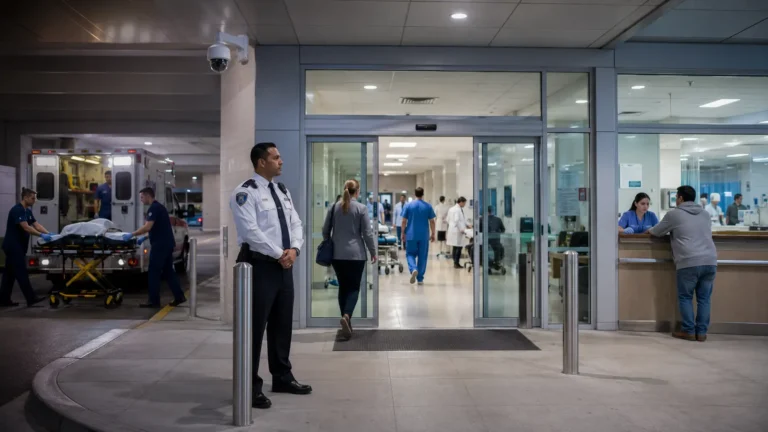
Healthcare facilities have a unique security challenge: they must remain accessible to patients, families, visitors, clinicians, emergency responders, and support personnel while also protecting people from violence, threats, aggression, and unauthorized activity.
Workplace violence in healthcare can range from verbal threats and intimidation to physical assaults and other serious incidents. OSHA identifies healthcare as a sector with significant workplace-violence risks and recommends a comprehensive prevention program built around management commitment, employee involvement, worksite analysis, hazard prevention and control, training, recordkeeping, and program evaluation.
Preventing violence is therefore not simply a matter of placing security guards at hospital entrances. Effective healthcare security combines risk assessment, environmental design, access control, trained personnel, communication, de-escalation, emergency procedures, incident reporting, and continuous improvement.
Why Violence Prevention Matters in Healthcare
Healthcare workers regularly operate in situations that can involve fear, pain, emotional distress, long waiting periods, substance use, behavioral health emergencies, or disagreements between patients, visitors, and staff.
OSHA identifies several conditions that can increase workplace-violence risk, including overcrowded waiting areas, long service delays, working alone, inadequate security, unrestricted public movement, poor lighting, understaffing, and insufficient training for managing potentially volatile situations.
The consequences can extend beyond physical injury. Workplace violence can affect employee morale, absenteeism, turnover, psychological well-being, and patient care. The CDC’s NIOSH program also notes that workplace violence can have both physical and psychological effects on workers.
What Does Healthcare Workplace Violence Include?
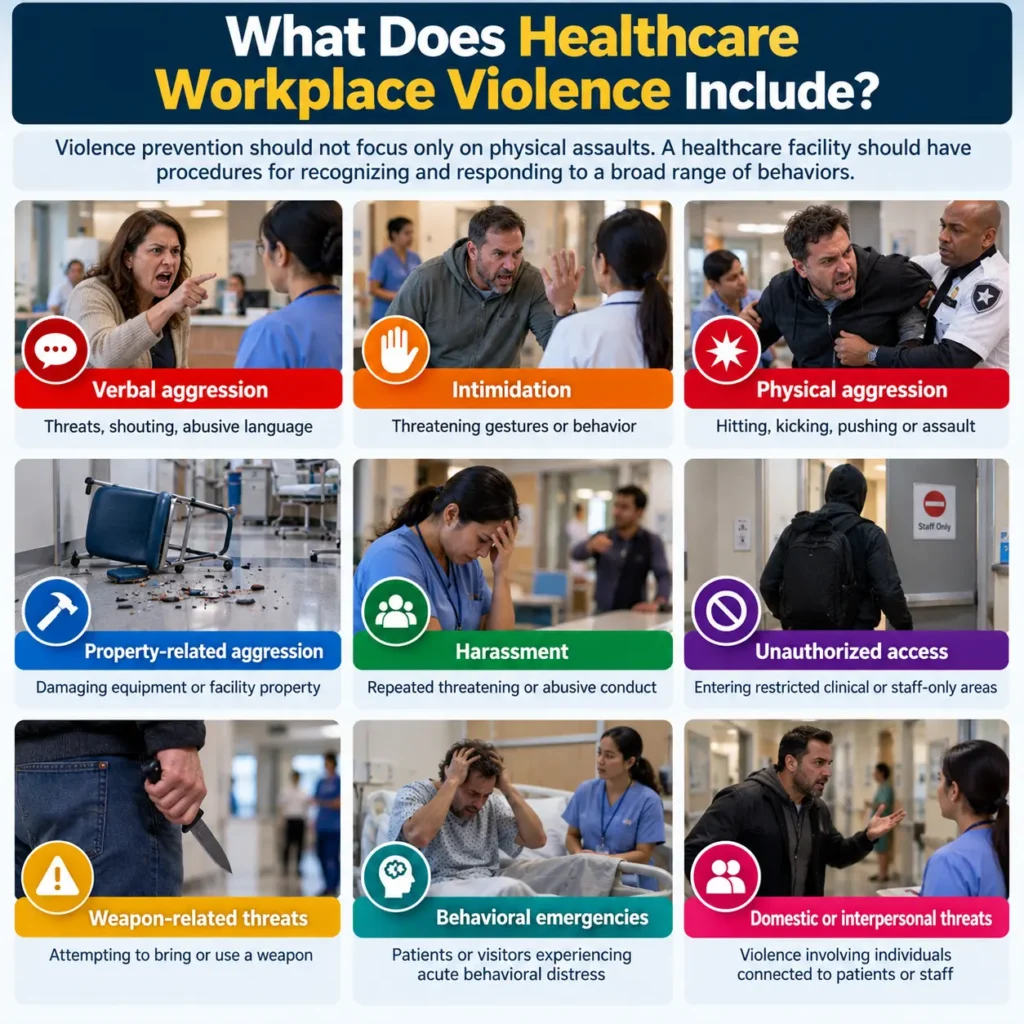
Violence prevention should not focus only on physical assaults.
A healthcare facility should have procedures for recognizing and responding to a broad range of behaviors.
| Type of incident | Examples |
|---|---|
| Verbal aggression | Threats, shouting, abusive language |
| Intimidation | Threatening gestures or behavior |
| Physical aggression | Hitting, kicking, pushing or assault |
| Property-related aggression | Damaging equipment or facility property |
| Harassment | Repeated threatening or abusive conduct |
| Unauthorized access | Entering restricted clinical or staff-only areas |
| Weapon-related threats | Attempting to bring or use a weapon |
| Behavioral emergencies | Patients or visitors experiencing acute behavioral distress |
| Domestic or interpersonal threats | Violence involving individuals connected to patients or staff |
The objective is to identify concerning behavior before it escalates whenever possible.
1. Conduct a Healthcare Security Risk Assessment
Every facility has a different risk profile.
A large emergency department, behavioral health facility, outpatient clinic, nursing facility, and specialty medical office should not necessarily use the same security model.
A security risk assessment should examine:
- Patient population
- Facility location
- Operating hours
- Emergency department activity
- Behavioral health services
- Previous security incidents
- Visitor volume
- Public access points
- Staff-only areas
- Parking facilities
- Loading and service areas
- Pharmacy and medication storage
- High-value equipment
- Restricted clinical areas
- Security staffing
- CCTV coverage
- Access-control systems
- Lighting
- Emergency communication systems
- Existing response procedures
Historical incident data is particularly useful because it can reveal patterns that are not obvious during a routine walkthrough.
For example, incidents may cluster around particular departments, times of day, entrances, waiting areas, parking areas, or types of patient interactions.
The Joint Commission’s current workplace-violence framework emphasizes worksite analysis, data collection, training, reporting, post-incident strategies, and leadership oversight.
2. Identify High-Risk Areas
Not every part of a healthcare facility presents the same security exposure.
Security teams should identify locations where violence is more likely to occur or where an incident could have particularly serious consequences.
Common areas requiring additional consideration include:
- Emergency departments
- Psychiatric and behavioral health units
- Waiting rooms
- Patient intake areas
- Ambulance entrances
- Pediatric areas
- Staff entrances
- Parking garages
- Parking lots
- Medication storage areas
- Security-sensitive clinical areas
- Reception desks
- After-hours entrances
- Hallways connecting public and restricted areas
Risk does not automatically mean that every location needs a permanent security post. Instead, the facility should determine which combination of controls is appropriate for each location.
3. Strengthen Access Control
Healthcare facilities need to balance security with accessibility.
Patients need to enter easily. Emergency responders need rapid access. Staff need efficient movement between departments. Visitors need clear directions.
At the same time, unrestricted movement throughout the facility can create unnecessary security exposure.
Access controls can include:
- Badge-controlled staff entrances
- Visitor identification procedures
- Electronic access-control systems
- Restricted elevator access
- Controlled entrances after normal hours
- Visitor badges
- Staff-only doors
- Access logs
- Security escorts when appropriate
- Separation of public and restricted areas
The objective is not to make a healthcare facility feel like a fortress. It is to establish appropriate boundaries between public, semi-restricted, and restricted areas.
4. Improve Visibility and Environmental Design
The physical environment can influence security risk.
OSHA identifies poor environmental design and inadequate lighting among factors associated with workplace violence in healthcare settings.
Facilities should evaluate:
- Lighting in parking areas
- Visibility around entrances
- Blind corners
- Obstructed hallways
- Reception-desk positioning
- Waiting-room layout
- Door visibility
- Emergency exits
- Staff escape routes
- Landscaping
- CCTV coverage
- Visibility around elevators and stairwells
Reception desks and security posts should, where practical, provide good visibility of the areas they are responsible for monitoring.
Environmental design should also avoid creating situations where employees can become trapped in a room or isolated from assistance.
5. Use Security Cameras Strategically
CCTV can support healthcare security, but cameras should be part of a broader security system rather than treated as a standalone solution.
Useful camera locations may include:
- Main entrances
- Emergency entrances
- Parking areas
- Parking garages
- Loading docks
- Public corridors
- Exterior approaches
- Restricted access points
- Other locations identified through risk assessment
Camera placement should consider privacy requirements and the sensitive nature of healthcare environments.
The goal is to provide useful situational awareness, support investigations, and help security personnel identify developing problems.
6. Train Employees to Recognize Warning Signs
Security personnel cannot be everywhere at once.
Healthcare employees are often the people closest to patients and visitors and may notice changes in behavior before a security incident occurs.
Training can help employees recognize:
- Escalating verbal aggression
- Threatening statements
- Agitated behavior
- Repeated attempts to enter restricted areas
- Intimidation
- Increasingly confrontational behavior
- Signs that a situation is becoming unsafe
Training should also make clear when employees should stop attempting to manage a situation themselves and request security or emergency assistance.
The Joint Commission identifies role-specific education and training as an important component of workplace-violence prevention programs.
7. Make De-Escalation Part of the Security Strategy
De-escalation can help prevent some confrontations from becoming physical.
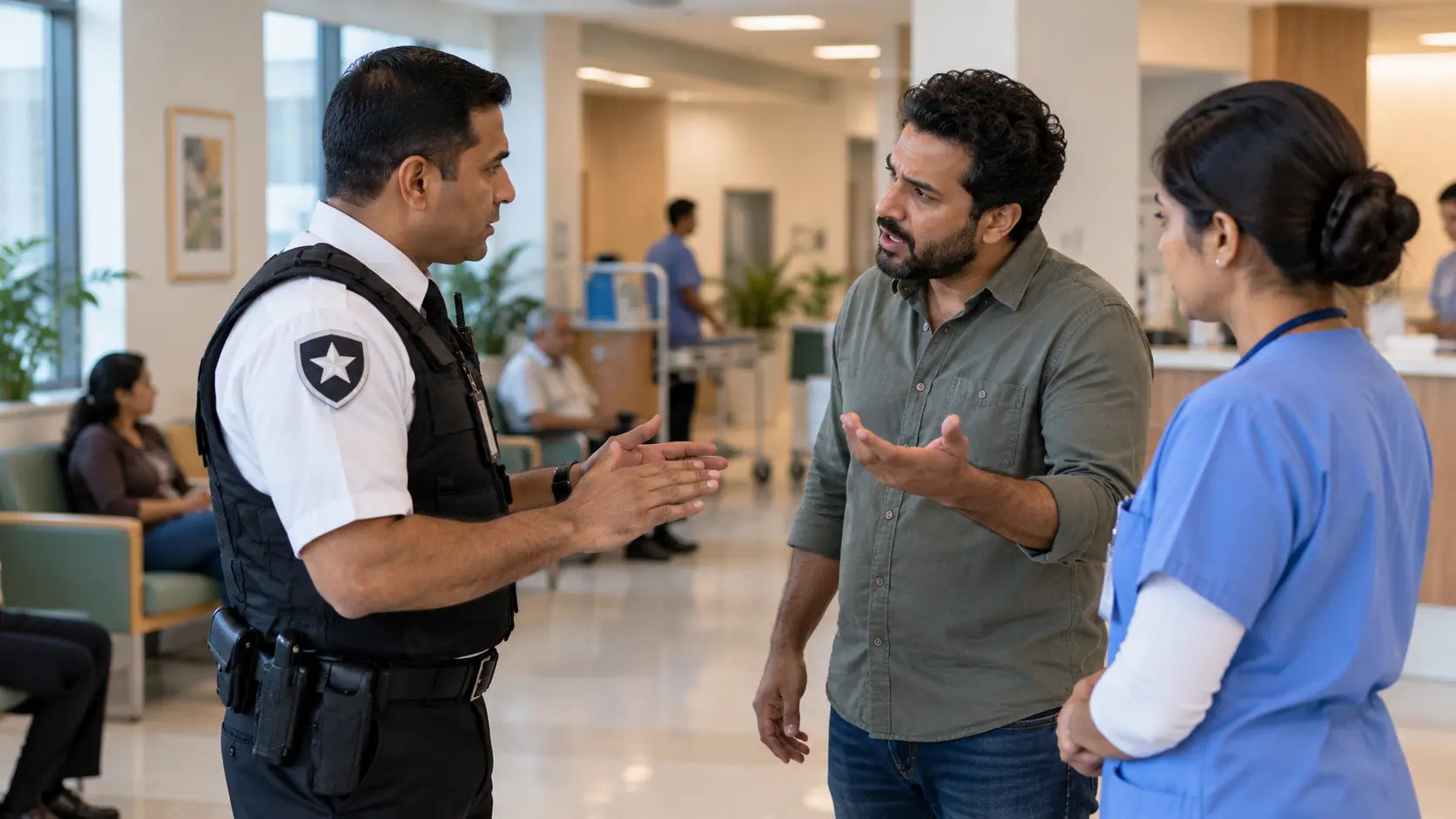
Healthcare personnel and security officers should be trained according to their roles and facility procedures.
Common principles include:
- Maintain a calm tone
- Listen without unnecessarily arguing
- Avoid threatening language
- Give the person reasonable personal space
- Avoid crowding or surrounding the individual unnecessarily
- Use clear and simple communication
- Establish appropriate boundaries
- Call for assistance early when risk is increasing
- Maintain an appropriate escape route
- Follow facility-specific emergency procedures
De-escalation does not mean tolerating threats or allowing unsafe behavior to continue indefinitely.
The objective is to reduce tension while maintaining appropriate safety boundaries.
8. Establish Clear Security Guard Roles
Security guards can play an important role in healthcare violence prevention, but their responsibilities should be clearly defined.
Depending on the facility and contract, security personnel may assist with:
- Access control
- Visitor management
- Patrols
- CCTV monitoring
- Incident response
- Staff assistance
- Emergency notifications
- Restricted-area monitoring
- Parking-area security
- Escort services
- Incident documentation
- Coordination with facility leadership and emergency responders
Security personnel should understand the facility’s policies, emergency procedures, communication protocols, and escalation requirements.
They should also understand the limits of their authority. Private security personnel are not a substitute for law enforcement or clinical professionals.
9. Create a Rapid Communication System
During an escalating situation, delays in communication can make response more difficult.
Healthcare facilities should establish clear procedures for requesting assistance.
Depending on the facility, communication may involve:
- Radios
- Panic buttons
- Staff emergency buttons
- Mobile communication systems
- Overhead announcements
- Dedicated emergency phone lines
- Security dispatch
- Duress systems
- Emergency notification systems
Employees should know who to contact, how to contact them, and what information to provide.
A security response system is only useful if employees know how to activate it and understand when to use it.
10. Establish Clear Emergency Response Procedures
A written workplace-violence response plan should address different types of incidents rather than relying on a single generic procedure.
The plan should define:
- How employees report a threat
- How security is notified
- Who assumes operational responsibility
- When supervisors are notified
- When emergency services are contacted
- How affected areas are controlled
- How patients and visitors are protected
- How staff receive instructions
- How the incident is documented
- How the facility resumes normal operations
Procedures should be practiced periodically so that employees are familiar with their responsibilities.
11. Pay Particular Attention to Emergency Departments
Emergency departments can present unique security challenges.
Patients may arrive under significant emotional or physical stress. Some situations may involve substance use, behavioral emergencies, interpersonal conflicts, criminal activity, or other circumstances requiring coordinated response.
OSHA specifically identifies emergency departments as areas where workplace-violence hazards require attention.
Security planning for an emergency department may include:
- Controlled entrances
- Visitor-management procedures
- Security presence during higher-risk periods
- CCTV coverage
- Staff emergency-alert systems
- Clear response procedures
- Coordination with clinical personnel
- Appropriate law-enforcement coordination
- Regular review of incident patterns
Security measures should be designed around the facility’s actual risk profile rather than simply adding guards without understanding the underlying vulnerabilities.
12. Secure Parking Areas and Staff Entrances
Security risks do not stop at the hospital doors.
Employees may encounter security concerns while arriving at or leaving work, particularly during overnight or early-morning shifts.
Facilities should evaluate:
- Parking-lot lighting
- Parking-garage visibility
- CCTV coverage
- Emergency call stations
- Staff entrance security
- Landscaping and hiding places
- Patrol frequency
- Escort procedures
- Access control
- Vehicle and pedestrian routes
OSHA’s hospital guidance specifically identifies security escorts and shuttle services as potential measures for improving worker safety during arrival and departure.
13. Control Visitor Access
Visitor management is an important part of healthcare security.
Facilities should establish consistent procedures for:
- Visitor identification
- Visiting hours
- Visitor badges
- Restricted departments
- After-hours visitors
- Children and vulnerable visitors
- Visitors who refuse facility rules
- Individuals who are not authorized to enter
- Visitors involved in an ongoing dispute
Employees should not have to improvise visitor-control procedures during a confrontation.
Clear policies give staff and security personnel a consistent framework for responding.
14. Pay Attention to Staffing and Isolation
Working alone or with inadequate staffing can increase exposure to security risks.
Facilities should identify positions where employees routinely:
- Work alone
- Work overnight
- Move through isolated areas
- Handle distressed patients
- Interact with potentially aggressive visitors
- Perform duties away from security or clinical support
Where appropriate, facilities can consider buddy systems, scheduled security checks, communication devices, escorts, or changes to staffing patterns.
OSHA lists working alone and inadequate staffing among factors that can contribute to workplace-violence risk.
15. Create a Strong Incident Reporting Process
An incident that is not documented is difficult to analyze.
Healthcare organizations should encourage employees to report threats, assaults, aggressive behavior, and significant near misses according to facility policy.
Reports should capture factual information such as:
- Date and time
- Location
- People involved
- What happened
- Observable behavior
- Actions taken
- Security response
- Injuries or property damage
- Witness information
- Notifications made
- Follow-up actions
Reports should avoid unsupported assumptions about a person’s motives, diagnosis, or mental state.
Good documentation helps management identify recurring problems and determine whether corrective measures are working.
The Joint Commission specifically emphasizes reporting systems, data collection and analysis, and post-incident strategies within workplace-violence prevention programs.
16. Analyze Incidents for Patterns
The purpose of incident reporting is not simply to create paperwork.
Management should periodically examine the data.
For example:
| Pattern | Possible security question |
|---|---|
| Repeated incidents in one department | Does the area need environmental or procedural changes? |
| Incidents concentrated at night | Is staffing or security coverage appropriate? |
| Frequent visitor disputes | Are visitor policies clear and consistently enforced? |
| Repeated emergency-department incidents | Are response procedures and staffing adequate? |
| Parking-related complaints | Are lighting, cameras and patrols sufficient? |
| Increasing verbal threats | Are early intervention and reporting procedures working? |
| Repeated unauthorized access | Are access controls functioning properly? |
The goal is to move from reactive security to preventive security.
17. Conduct Regular Security Drills and Training
Training should not end after employee orientation.
Healthcare facilities should periodically review:
- Workplace-violence policies
- De-escalation procedures
- Emergency communication
- Security notification procedures
- Access-control procedures
- Evacuation or shelter procedures where applicable
- Incident reporting
- Staff responsibilities
- Security response procedures
Training should reflect the employee’s actual role.
A nurse, receptionist, security officer, facilities employee, administrator, and clinician may encounter different risks and therefore require different training.
For Joint Commission-accredited hospitals and critical access hospitals, the current workplace-violence framework includes training, education, and resources for leaders, staff, and licensed practitioners.
18. Support Employees After an Incident
Violence prevention does not end when the immediate threat is over.
Employees affected by violence may require:
- Medical evaluation
- Immediate supervisor support
- Incident documentation
- Appropriate reporting
- Psychological or employee-assistance resources
- Follow-up communication
- Workplace adjustments where appropriate
Post-incident support is also useful for identifying weaknesses in the existing prevention program.
The Joint Commission’s workplace-violence framework specifically includes post-incident strategies and support as part of an effective prevention system.
19. Review the Security Program Regularly
A healthcare security program should evolve as the facility changes.
A review may be necessary after:
- A serious incident
- A pattern of repeated incidents
- A major renovation
- A change in patient population
- A new clinical service
- Changes in operating hours
- Changes in staffing
- Changes in visitor volume
- New security technology
- Changes in local risk conditions
OSHA describes workplace-violence prevention as an ongoing program requiring continual assessment and improvement rather than a one-time project.
A Practical Healthcare Violence Prevention Checklist
Healthcare administrators and facility managers can use the following checklist as a starting point:
| Security area | Key question |
|---|---|
| Risk assessment | Have current violence risks been formally assessed? |
| Incident data | Are incidents and near misses being analyzed? |
| Access control | Are restricted areas adequately protected? |
| Visitor management | Are visitor procedures clear and consistently applied? |
| CCTV | Are critical areas adequately monitored? |
| Lighting | Are parking and exterior areas adequately illuminated? |
| Communication | Can employees quickly summon assistance? |
| Training | Are employees trained for their specific roles? |
| De-escalation | Do appropriate staff understand de-escalation procedures? |
| Security staffing | Does coverage reflect actual risk patterns? |
| Emergency response | Are escalation and emergency procedures documented? |
| Reporting | Are incidents documented consistently? |
| Post-incident review | Are incidents followed by corrective-action reviews? |
| Employee support | Are affected employees provided appropriate follow-up? |
| Program review | Is the security program regularly reassessed? |
Common Mistakes Healthcare Facilities Should Avoid
Treating security as only a guard-staffing issue
Adding security officers may address part of a problem, but it does not automatically correct poor access control, inadequate lighting, weak reporting procedures, or insufficient employee training.
Waiting for a serious assault before taking action
Repeated threats, aggressive behavior, unauthorized access attempts, and near misses can provide useful warning information.
Ignoring environmental problems
A poorly designed entrance, isolated parking area, blind corridor, or unsecured staff entrance can contribute to security exposure.
Failing to document incidents
Without reliable data, management may have difficulty identifying patterns or demonstrating whether corrective measures are effective.
Using the same security plan everywhere
An emergency department, outpatient clinic, behavioral health facility, and medical office have different operating environments and security requirements.
Relying entirely on technology
Cameras, access-control systems, alarms, and communication devices are useful tools, but they work best when combined with trained personnel, clear procedures, and active management.
How Security Companies Can Support Healthcare Facilities
A professional security provider can support a healthcare organization by helping implement a security program appropriate to the facility’s risk profile.
Services may include:
- Healthcare security officers
- Security patrols
- Access-control support
- Visitor management
- CCTV monitoring
- Emergency response support
- Staff escorts
- Incident documentation
- Security assessments
- Security supervisor coverage
- Event or high-risk-period staffing
Before hiring a security company, healthcare administrators should evaluate whether the provider understands the operating environment of healthcare facilities.
Important questions include:
- Does the company have healthcare security experience?
- How are officers trained?
- How are supervisors assigned?
- What is the emergency-response procedure?
- How are incidents documented?
- How does the company coordinate with facility management?
- What communication systems are used?
- Can staffing levels be adjusted based on risk?
- How are officers evaluated?
- What happens after a serious incident?
The Goal Is Prevention, Not Just Response
The strongest healthcare security programs do not wait for violence to occur before taking action.
They combine risk assessment, employee participation, environmental controls, access management, trained security personnel, communication systems, de-escalation practices, incident reporting, and continuous program improvement.
OSHA recommends a comprehensive workplace-violence prevention approach, while the Joint Commission’s current framework emphasizes leadership oversight, worksite analysis, reporting and data analysis, training, and post-incident strategies.
For healthcare facilities, the most useful question is therefore not simply, “How many security guards do we need?”
It is:
“What combination of people, procedures, technology, environmental controls, and training will reduce our specific security risks while allowing staff to provide safe and effective patient care?”
Frequently Asked Questions
What is the best way to prevent violence in a healthcare facility?
There is no single measure that works for every facility. A comprehensive program should combine security risk assessment, access control, environmental design, employee training, de-escalation, communication, incident reporting, appropriate security staffing, and ongoing program evaluation.
Should every hospital have security guards?
Security staffing should be based on the facility’s risk profile, operating environment, incident history, size, patient population, and security requirements. A risk assessment can help determine where and when security personnel are most useful.
Can security guards prevent all healthcare violence?
No. Security officers can provide deterrence, monitoring, access control, response, and assistance, but they cannot eliminate every source of violence. Effective prevention requires coordination between security, clinical staff, management, facilities, and other relevant personnel.
Why is incident reporting important?
Incident reports create a record that can help organizations identify patterns, high-risk locations, recurring triggers, and weaknesses in existing procedures. That information can then support corrective action.
Is de-escalation enough to prevent violence?
De-escalation can be an important preventive tool, but it is not appropriate for every situation. Employees should know when to disengage, seek assistance, and follow emergency procedures.
How often should healthcare security assessments be performed?
Facilities should establish a regular review process and reassess security after significant incidents, operational changes, renovations, changes in patient populations, or other events that could alter the risk profile.
Final Thoughts
Preventing violence in healthcare facilities requires more than a visible security presence.
The most effective approach is a layered system in which management, healthcare workers, security personnel, facilities teams, and other stakeholders understand their responsibilities and work from the same prevention strategy.
By identifying risks early, improving the physical environment, controlling access, training employees, strengthening communication, documenting incidents, and reviewing security performance over time, healthcare organizations can build a safer environment for patients, visitors, and staff.